
Filters
Documents containing immun
Showing 25 of 115 items meeting your criteria.
| Type | Category | Supplier | ||
|---|---|---|---|---|
 | MBL is able to create an in-house library of antibodies derived from animals immunised with the desired target molecules. | |||
Documents | Service | MBL | ||
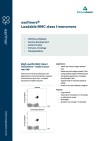 | High-quality MHC class I monomers – made in your own lab. Save time and money by making your own peptide MHC monomers/multimers. Generate monomers from day-to-day – no special equipment or expertise required. | |||
Documents | Tetramers | immunAware | ||
 | immunAwares pMHC stability assay can assist you in selecting epitopes that not only bind effectively to MHC molecules, but also lead to prolonged presentation to T cells. | |||
Documents | Service | immunAware | ||
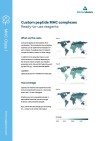 | Expand your research and explore the human immune diversity with access to > 90 human class I and > 15 class II allotypes & create custom MHC complexes. | |||
Documents | Service | immunAware | ||
 | immunAwares HLA repertoire covers 90+ HLA class I, 15 HLA class II allotypes, allowing you to address the human HLA diversity. They provide custom production of pMHC mono- or tetramers, binding and stability analysis of pMHC complexes according to your needs. Their HLAs are recombinantly expressed, extensively purified and natural HLAs (no artificial Cys-bonds). | |||
Documents | Supplier Introduction | immunAware | ||
 | KACTUS has developed a catalogue of full-length multipass transmembrane proteins displayed on virus-like particles (VLPs) or copolymer nanodiscs for immunisation, affinity testing, PK/PD studies, antibody characterisation and other drug discovery applications. | |||
Documents | Proteins | KactusBio Inc. | ||
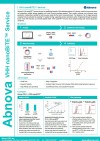 | Abnovas VHH nanoBiTE™ service focuses on developing bispecific VHH antibodies without an Fc domain, ideal for immune and tumor cell redirecting, multiple epitope targeting, and novel immuno-oncology research. Their smaller molecular size enhances tissue penetration, making them suitable for hard-to-access areas like the tumor microenvironment. The absence of an Fc region prevents unwanted immune activation by avoiding Fc receptor binding, supporting precise mechanistic action. Engineered through the genetic fusion of two VHH domains via a flexible peptide linker, VHH nanoBiTE™ ensures robust antigen binding with reduced production complexity. | |||
Documents | Service | Abnova Corporation | ||
 | Leadgene Indoxyl Sulfate (IS) ELISA Kit is a competitive enzyme-linked immunosorbent assay (competitive ELISA) for quantitative detecting total indoxyl sulfate (IS) levels in human serum samples. It is used as an aid in the diagnosis of renal function. However, it is intended for in vitro diagnostic use only, NOT suitable for use in therapeutic procedures. | |||
Documents | Datasheets | LeadGene Biomedical | ||
 | KACTUS excels in crafting and producing an array of superior-grade, highly active recombinant proteins and enzymes, catering to diverse sectors like antibody drug discovery, immunotherapy, biologics and cell therapy. Their expansive catalog, boasting over 3000 recombinant proteins, encompasses a wide spectrum of targets, species, tags, and labels, each thoughtfully chosen to address the specific, unmet needs of scientists engaged in drug development. The hallmark of their product selection process is a rigorous emphasis on exceptional quality and a steadfast commitment to ensuring reliable supply, thereby upholding the highest standards of excellence and client satisfaction. | |||
Documents | Catalogue | KactusBio Inc. | ||
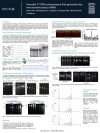 | In vitro transcription (IVT) utilizing T7 RNA polymerase (T7 RNAP) for the synthesis of messenger RNA (mRNA) is efficient and well-established for the production of large quantities of synthetic RNA. However, T7 RNAP can generate undesirable, immunostimulatory mRNA byproducts such as double-stranded RNA (dsRNA). To reduce these concerns, we rationally engineered a series of T7 RNAP mutants and compared their functional properties to those of wild-type and commercially available T7 RNAP. Among these characteristics are dsRNA, circular RNA, processivity, and yield. | |||
Documents | RNA | KactusBio Inc. | ||
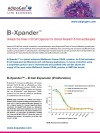 | Unleash the Power of B Cell Expansion for Clinical Research & Immunotherapies | |||
Documents | Cell Biology | AdipoGen Life Sciences | ||
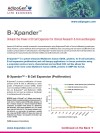 | Unleash the Power of B Cell Expansion for Clinical Research & Immunotherapies | |||
Documents | Cell Biology | AdipoGen Life Sciences | ||
 | Catalogue and custom services for MHC Monomers, Tetramers, and Soluble TCRs to meet various needs in immunotherapy research. KACTUS team has extensive experience in MHC and TCR engineering and expression and performs quality testing for bioactivity. | |||
Documents | Tetramers | KactusBio Inc. | ||
 | KACTUS has developed a proprietary AAV immunisation scheme to generate high-affinity monoclonal antibodies. With this immunisation scheme, they can create custom kits specific to AAV variants. | |||
Documents | ELISA | KactusBio Inc. | ||
 | KACTUS provides a catalogue of CD3 homodimers and heterodimers with equal expression of subunites, applicable for immunotherapy and other research. | |||
Documents | Recombinant Proteins | KactusBio Inc. | ||
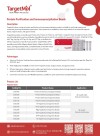 | TargetMol offers a range of protein purification and immunoprecipitation products. These products are available in 3 types based on the material - magnetic beads, magrose beads and agarose beads. | |||
Documents | Beads | TargetMol | ||
 | TargetMol offers various inhibitors, agonists, cytokines and compound libraries targeting different pathways and targets related to immunity and inflammation, to meet the needs of various research fields. | |||
Documents | Immunology | TargetMol | ||
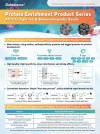 | Elabscience provides products for protein enrichment. | |||
Documents | Beads | Elabscience | ||
 | NRicher™ Ig for Enrichment of all isotypes and subclasses of Immunoglobulins | |||
Documents | Sample Prep | Biotech Support Group | ||
 | Abnovas new bioactive proteins offer exceptional purity and confirmed bioactivity, making them indispensable for various research applications. These proteins, which include CD Proteins, MHC Proteins, Immune Checkpoint Proteins, FGFR Family Proteins, VLP-Displayed Antigens, and other targets, are produced using HEK293 mammalian expression systems to maintain their natural conformation and functionality. All bioactive proteins undergo functional assays to confirm their activity. Through rigorous HPLC analysis, all products achieve over 95% purity. Additionally, the endotoxin levels are less than 1EU/μg detected by the LAL method, ensuring that Abnovas bioactive proteins meet the highest standards for research and therapeutic development. | |||
Documents | Proteins | Abnova Corporation | ||
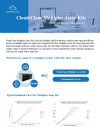 | Cloud-Clone Multiplex Assay Kits, based on Multiplex xMAP technology, enable to make rapid and efficient analysis of multiple targets in a single well. | |||
Documents | Multiplex Assays | Cloud-Clone Corp. | ||
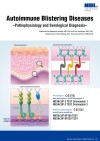 | Pathophysiology and Serological Diagnosis | |||
Documents | ELISA | MBL | ||
 | Autoimmune Blistering Diseases (ABDs) are a group of disorders associated with autoantibodies that are directed against desmosomal structural proteins (Pemphigus) or hemidesmosomal proteins (Bullous Pemphigoid and Epidermolysis Bullosa Acquisita). MBL offers ELISA kits for detection and monitoring of ABDs. | |||
Documents | ELISA | MBL | ||
 | Protein G is a well-established ligand for affinity chromatography resins used for isolation and characterization of immunoglobulins. Protein G binds to the Fc region of mammalian IgGs thus exhibiting high affinity for many IgG subclasses including human, rabbit, mouse, rat, sheep, pig, horse, cow or goat. In contrast to protein A, protein G binds all human and mouse IgG subclasses, including human IgG3 and mouse IgG1 as well as all rat IgG subclasses. Furthermore, protein G also binds to CH1 portion of the Fab region making this ligand well-suited for the purification of more complex constructs such as bispecific antibodies. | |||
Documents | Resins | Agarose Bead Technologies | ||
 | Protein G Agarose 4 Rapid Run™ is an affinity chromatography resin developed by Agarose Bead Technologies for purification of immunoglobulins. | |||
Documents | Resins | Agarose Bead Technologies | ||