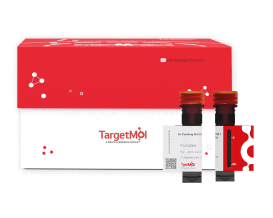
TargetMol

CFSE (Cell Proliferation Tracer Fluorescent Probe)

Product Code:
 
TAR-C0162
Product Group:
 
Dyes, Stains, and Probes
Supplier:
 
TargetMol
Regulatory Status:
 
RUO
Shipping:
 
Cool pack
Storage:
 
-20°C
1 / 1

No additional charges, what you see is what you pay! *

CodeSizePrice
TAR-C0162-1mL1 mL£129.00
Quantity:
Prices exclude any Taxes / VAT
Stay in control of your spending. These prices have no additional charges to UK mainland customers, not even shipping!
* Rare exceptions are clearly labelled (only 0.14% of items!).
Multibuy discounts available! Contact us to find what you can save.
This product comes from: Austria.
Typical lead time: 10-14 working days.
Contact us for more accurate information.
  • Further Information
  • Documents
  • Show All

Further Information

Bioactivity:
CFSE (Carboxyfluorescein diacetate, succinimidyl ester) is a fluorescent probe commonly used for detecting cell proliferation and tracing. CFSE is a derivative of fluorescein diacetate (FDA), featuring good cell membrane permeability, and is non-fluorescent in its native form. The principle of CFSE in proliferation detection and tracing is as follows: once CFSE enters viable cells, intracellular esterases specifically hydrolyze it, removing the acetate groups and generating carboxyfluorescein succinimidyl ester (CFSE). This product covalently binds to intracellular proteins via amino groups, thereby allowing CFSE to be stably retained within the cells and emit bright green fluorescence (excitation wavelength: 492 nm; emission wavelength: 517 nm). When CFSE-labeled cells divide, the fluorescence is equally distributed between the two daughter cells, causing the fluorescence intensity of each daughter cell to be half that of the parent cell. By monitoring the changes in green fluorescence intensity, it is possible to clearly distinguish undivided cells from cells that have undergone different numbers of divisions. As cell division progresses, the gradient changes in fluorescence intensity can be used to trace the process of cell proliferation, the number of divisions, as well as cell migration and distribution both in vitro and in vivo.
Purity:
96.58%

Documents