

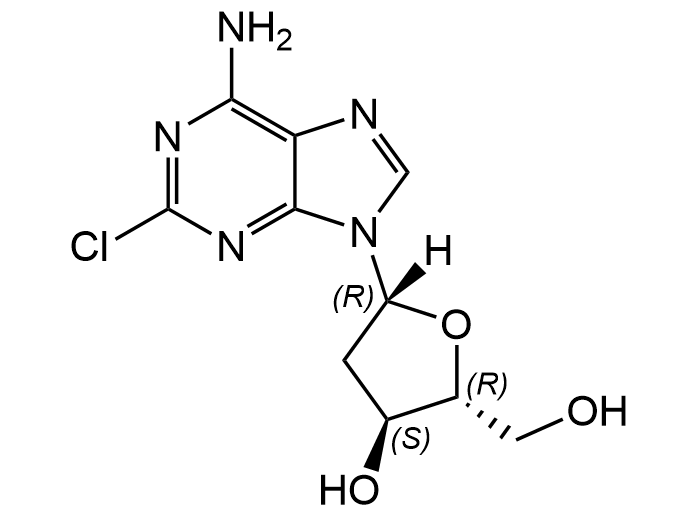
2-Chloro-2'-deoxyadenosine
Product Code:
CDX-C0805
CDX-C0805
Product Group:
Other Biochemicals
Other Biochemicals
Supplier:
Chemodex
Chemodex
Regulatory Status:
RUO
RUO
Shipping:
Ambient
Ambient
Storage:
Short term: +20°C. Long term: +4°C.
Short term: +20°C. Long term: +4°C.

No additional charges, what you see is what you pay! *
Stay in control of your spending. These prices have no additional charges to UK mainland customers, not even shipping!
* Rare exceptions are clearly labelled (only 0.14% of items!).
* Rare exceptions are clearly labelled (only 0.14% of items!).
Multibuy discounts available! Contact us to find what you can save.
This product comes from: Switzerland.
Typical lead time: 7-10 working days.
Contact us for more accurate information.
Typical lead time: 7-10 working days.
Contact us for more accurate information.
- Further Information
- Documents
- References
- Show All
Further Information
Appearance:
White to off-white powder.
CAS:
4291-63-8
EClass:
32160000
Form:
solid
GHS Symbol:
GHS06, GHS08
Handling Advice:
Protect from light and moisture.
Hazards:
H301-H341-H361fd-H372
InChi:
InChI=1S/C10H12ClN5O3/c11-10-14-8(12)7-9(15-10)16(3-13-7)6-1-4(18)5(2-17)19-6/h3-6,17-18H,1-2H2,(H2,12,14,15)/t4-,5+,6+/m0/s1
InChiKey:
PTOAARAWEBMLNO-KVQBGUIXSA-N
Long Description:
Chemical. CAS: 4291-63-8. Formula: C10H12ClN5O3. MW: 285.69. 2-Chloro-2'-deoxyadenosine is a synthetic anticancer purine nucleoside analog commonly used in biochemical and cellular research to study nucleoside metabolism, DNA synthesis, and apoptosis pathways. Due to its resistance to adenosine deaminase-mediated degradation, this compound exhibits enhanced stability in biological systems, making it a valuable tool for mechanistic studies involving DNA replication and repair. Cladribine is cytotoxic to resting or proliferating lymphocytes. It inhibits RNA synthesis and induces DNA strand breaks in resting human peripheral blood lymphocytes. Cladribine induces cell cycle arrest at the G1 phase and apoptosis in U266, RPMI-8226, and MM.1S multiple myeloma cells in a concentration-dependent manner. It reduces tumor growth in HT-29 colon cancer, RL lymphoma, and RPMI-8226 multiple myeloma mouse xenograft models.
MDL:
MFCD00153939
Molecular Formula:
C10H12ClN5O3
Molecular Weight:
285.69
Package Type:
Vial
PG:
III
Precautions:
P202-P260-P264-P280-P301+P310-P405
Product Description:
2-Chloro-2'-deoxyadenosine is a synthetic anticancer purine nucleoside analog commonly used in biochemical and cellular research to study nucleoside metabolism, DNA synthesis, and apoptosis pathways. Due to its resistance to adenosine deaminase-mediated degradation, this compound exhibits enhanced stability in biological systems, making it a valuable tool for mechanistic studies involving DNA replication and repair. Cladribine is cytotoxic to resting or proliferating lymphocytes. It inhibits RNA synthesis and induces DNA strand breaks in resting human peripheral blood lymphocytes. Cladribine induces cell cycle arrest at the G1 phase and apoptosis in U266, RPMI-8226, and MM.1S multiple myeloma cells in a concentration-dependent manner. It reduces tumor growth in HT-29 colon cancer, RL lymphoma, and RPMI-8226 multiple myeloma mouse xenograft models.
Purity:
>98% (HPLC)
Signal word:
Danger
SMILES:
NC1=C2C(N(C=N2)[C@@H]3O[C@H](CO)[C@@H](O)C3)=NC(Cl)=N1
Solubility Chemicals:
Soluble in DMSO (10mg/ml) or DMF (10mg/ml).
Transportation:
Excepted Quantity
UN Nummer:
UN2811
UNSPSC Category:
Biochemical Reagents
UNSPSC Number:
12352200
Use & Stability:
Stable for at least 2 years after receipt when stored at +4°C.
Documents
References
[1] D.A. Carson, et al.; Blood 62, 737 (1983) | [2] S. Seto, et al.; J. Clin. Invest. 75, 377 (1985) | [3] E. Beutler; Lancet 340, 952 (1992) (Review) | [4] A. Gorski, et al.; Immunopharmacol. 26, 197 (1993) | [5] S. Spurgeon, et al.; Expert Opin. Investig. Drugs 18, 1169 (2009) (Review) | [6] J. Ma, et al.; BMC Cancer 11, 255 (2011) | [7] T.P. Leist & R. Weissert; Clin. Neuropharmacol. 34, 28 (2011) (Review) | [8] R. Hermann, et al.; Clin. Pharmacokinet. 60, 1509 (2021) (Review) | [9] R. Hermann, et al.; Clin. Pharmacokinet. 61, 167 (2022) (Review)