

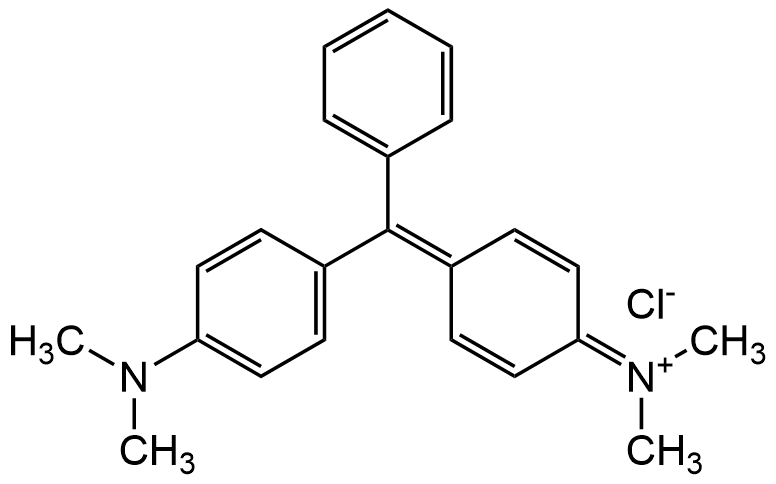
Malachite green
Product Code:
CDX-M0644
CDX-M0644
Product Group:
Dyes, Stains, and Probes
Dyes, Stains, and Probes
Supplier:
Chemodex
Chemodex
Regulatory Status:
RUO
RUO
Shipping:
Ambient
Ambient
Storage:
Short term: +20°C. Long term: +20°C.
Short term: +20°C. Long term: +20°C.

No additional charges, what you see is what you pay! *
Stay in control of your spending. These prices have no additional charges to UK mainland customers, not even shipping!
* Rare exceptions are clearly labelled (only 0.14% of items!).
* Rare exceptions are clearly labelled (only 0.14% of items!).
Multibuy discounts available! Contact us to find what you can save.
This product comes from: Switzerland.
Typical lead time: 7-10 working days.
Contact us for more accurate information.
Typical lead time: 7-10 working days.
Contact us for more accurate information.
- Further Information
- Documents
- References
- Show All
Further Information
Appearance:
Green to blue-green crystals or powder.
CAS:
569-64-2
EClass:
32160000
Form:
solid
GHS Symbol:
GHS05, GHS07, GHS09
Handling Advice:
Protect from light and moisture.
Hazards:
H302-H318-H361d-H410
InChi:
InChI=1S/C23H25N2.ClH/c1-24(2)21-14-10-19(11-15-21)23(18-8-6-5-7-9-18)20-12-16-22(17-13-20)25(3)4;/h5-17H,1-4H3;1H/q+1;/p-1
InChiKey:
FDZZZRQASAIRJF-UHFFFAOYSA-M
Long Description:
Chemical. CAS: 569-64-2. Formula: C23H25ClN2. MW: 364.91. Malachite Green is a synthetic cationic triphenylmethane organic dye widely used in laboratory, industrial, and research applications. Known for its vivid coloration and strong staining properties, Malachite Green is commonly employed in microscopy, biological staining, textile dyeing, and analytical procedures. Malachite Green chloride may be used as an analytical reference compound to investigate its carcinogenic nature and the analyte detection, food color quality, and safety control. It has efficacy for treating fungal, bacterial, and parasitic infections and is also employed in paper, textile, acrylic industries. It is used as a biological stain for microscopic analysis of cell biology and tissue samples. In the Gimenez staining method, basic fuchsin stains bacteria red or magenta, and malachite green is used as a blue-green counterstain. Malachite green is also used in endospore staining, since it can directly stain endospores within bacterial cells; here a safranin counterstain is often used. Malachite green is a part of Alexander's pollen stain. Malachite green is cytotoxic to HEp-2 cells and Caco-2 human colorectal adenocarcinoma cells. It reduces fungal infection in, and increases hatching rates of, rainbow trout eggs. The maximum absorbance wavelength is 621 nm.
MDL:
MFCD00011751
Molecular Formula:
C23H25ClN2
Molecular Weight:
364.91
Package Type:
Vial
PG:
III
Precautions:
P201-P273-P280-P301+P312+P330-P305+P351+P338+P310-P308+P313
Product Description:
Malachite Green is a synthetic cationic triphenylmethane organic dye widely used in laboratory, industrial, and research applications. Known for its vivid coloration and strong staining properties, Malachite Green is commonly employed in microscopy, biological staining, textile dyeing, and analytical procedures. Malachite Green chloride may be used as an analytical reference compound to investigate its carcinogenic nature and the analyte detection, food color quality, and safety control. It has efficacy for treating fungal, bacterial, and parasitic infections and is also employed in paper, textile, acrylic industries. It is used as a biological stain for microscopic analysis of cell biology and tissue samples. In the Gimenez staining method, basic fuchsin stains bacteria red or magenta, and malachite green is used as a blue-green counterstain. Malachite green is also used in endospore staining, since it can directly stain endospores within bacterial cells; here a safranin counterstain is often used. Malachite green is a part of Alexander's pollen stain. Malachite green is cytotoxic to HEp-2 cells and Caco-2 human colorectal adenocarcinoma cells. It reduces fungal infection in, and increases hatching rates of, rainbow trout eggs. The maximum absorbance wavelength is 621 nm.
Purity:
>75% (HPLC)
Signal word:
Danger
SMILES:
[Cl-].C=1C=CC(=CC1)C(C2=CC=C(C=C2)N(C)C)=C3C=CC(C=C3)=[N+](C)C
Solubility Chemicals:
Soluble in water (1mg/ml) or DMSO (10mg/ml).
Transportation:
Excepted Quantity
UN Nummer:
UN3077
UNSPSC Category:
Fluorescent Reagents
UNSPSC Number:
41105331
Use & Stability:
Stable for at least 2 years after receipt when stored at RT.
Documents
References
[1] A.A. Solari, et al.; Appl. Microbiol. 16, 792 (1968) | [2] R.J. Dutton, et al.; Appl. Environ. Microbiol. 46, 1263 (1983) | [3] A.A. Baykov, et al.; Anal. Biochem. 171, 266 (1988) | [4] N. Kitancharoen, et al.; Biocontrol Sci. 3, 113 (1998) | [5] A. Stammati, et al.; Toxicol. In Vitro 19, 853 (2005) | [6] J.S. Culp, et al.; Food Chem. Toxicol. 44, 1204 (2006) | [7] C.M.D. Swarbrick, et al.; Nucl. Acids Res. 45, 12904 (2017) | [8] X. Zhou, et al.; Crit. Rev. Anal. Chem. 49, 1 (2019) (Review) | [9] M.S. Gharavi-Nakhjavani, et l.; Environ. Sci. Pollut. Res. Int. 30, 48911 (2023) (Review) | [10] Y. Bian, et al.; Ecotoxicol. Environ. Saf. 303, 118978 (2025) (Review)