

DMAPB
Product Code:
AG-CR1-3904
AG-CR1-3904
Product Group:
Inhibitors and Activators
Inhibitors and Activators
Supplier:
AdipoGen Life Sciences
AdipoGen Life Sciences
Regulatory Status:
RUO
RUO
Shipping:
Ambient
Ambient
Storage:
Short term: +4°C. Long term: -20°C
Short term: +4°C. Long term: -20°C

No additional charges, what you see is what you pay! *
Stay in control of your spending. These prices have no additional charges to UK mainland customers, not even shipping!
* Rare exceptions are clearly labelled (only 0.14% of items!).
* Rare exceptions are clearly labelled (only 0.14% of items!).
Multibuy discounts available! Contact us to find what you can save.
This product comes from: Switzerland.
Typical lead time: 7-10 working days.
Contact us for more accurate information.
Typical lead time: 7-10 working days.
Contact us for more accurate information.
- Further Information
- Documents
- References
- Related Products
- Show All
Further Information
Alternate Names/Synonyms:
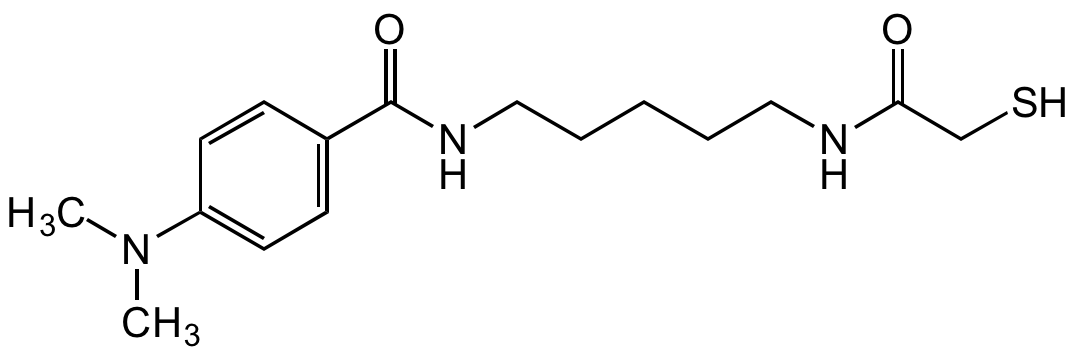
4-(Dimethylamino)-N-(5-(2-mercaptoacetamido)pentyl)benzamide; Mercaptoacetamide BC-4-55
Appearance:
Off-white solid.
CAS:
827036-76-0
EClass:
32160000
Form (Short):
liquid
Handling Advice:
Keep cool and dry.Protect from light.
InChi:
InChI=1S/C16H25N3O2S/c1-19(2)14-8-6-13(7-9-14)16(21)18-11-5-3-4-10-17-15(20)12-22/h6-9,22H,3-5,10-12H2,1-2H3,(H,17,20)(H,18,21)
InChiKey:
SGOHSANPZHQNKM-UHFFFAOYSA-N
Long Description:
Chemical. CAS: 827036-76-0. Formula: C16H25N3O2S. MW: 323.5. Cell permeable, potent and selective class IIb HDAC6 inhibitor (IC50 =114nM). Displays selectivity over other HDACs (IC50=1-8µM). Neuroprotective and anti-neuroinflammatory agent. Reduced neuronal degeneration after traumatic brain injury (TBI). Shown to increase histone H3 acetylation. HDAC6 deacetylates tubulin, HSP90 and the core histones (H2A, H2B, H3, H4). Histone deacetylases act via the formation of large multiprotein complexes. HDAC6 plays an important role in microtubule-dependent cell motility, transcriptional regulation, degradation of misfolded proteins and cell cycle and is involved in autophagy, inflammation, cancer and neurodegeneration.
Molecular Formula:
C16H25N3O2S
Molecular Weight:
323.5
Package Type:
Vial
Product Description:
Cell permeable, potent and selective class IIb HDAC6 inhibitor (IC50 =114nM). Displays selectivity over other HDACs (IC50=1-8µM). Neuroprotective and anti-neuroinflammatory agent. Reduced neuronal degeneration after traumatic brain injury (TBI). Shown to increase histone H3 acetylation. HDAC6 deacetylates tubulin, HSP90 and the core histones (H2A, H2B, H3, H4). Histone deacetylases act via the formation of large multiprotein complexes. HDAC6 plays an important role in microtubule-dependent cell motility, transcriptional regulation, degradation of misfolded proteins and cell cycle and is involved in autophagy, inflammation, cancer and neurodegeneration.
Purity:
>95% (HPLC)
SMILES:
CN(C)C1=CC=C(C=C1)C(=O)NCCCCCNC(=O)CS
Solubility Chemicals:
Soluble in DMSO, ethanol or methanol.
Transportation:
Non-hazardous
UNSPSC Category:
Biochemical Reagents
UNSPSC Number:
12352200
Use & Stability:
Stable for at least 2 years after receipt when stored at -20°C.
Documents
References
Chemistry and biology of mercaptoacetamides as novel histone deacetylase inhibitors: B. Chen, et al.; Bioorg. Med. Chem. Lett. 15, 1389 (2005) | Functional differences in epigenetic modulators - Superiority of mercaptoacetamide-based histone deacetylase inhibitors relative to hydroxamates in cortical neuron neuroprotection studies: A. Kozikowski, et al.; J. Med. Chem. 50, 3054 (2007) | In vitro plasma stability, permeability and solubility of mercaptoacetamide histone deacetylase inhibitors: R. Konsoula & M. Jung; Int. J. Pharm. 361, 19 (2008) | HDAC inhibitor increases histone H3 acetylation and reduces microglia inflammatory response following traumatic brain injury in rats: B. Zhang, et al.; Brain Res. 1226, 181 (2008) | Novel inhibitors of human histone deacetylase (HDAC) identified by QSAR modeling of known inhibitors, virtual screening, and experimental validation: H. Tang, et al.; J. Chem. Inf. Model 49, 461 (2009)
Related Products
| Product Name | Product Code | Supplier | Nexturastat A | AG-CR1-3901 | AdipoGen Life Sciences | Summary Details | |||||||||||||||||||||||||||||||||||||||||||||||||||||||||||||||||||||||||||||||||||||||||||||
|---|---|---|---|---|---|---|---|---|---|---|---|---|---|---|---|---|---|---|---|---|---|---|---|---|---|---|---|---|---|---|---|---|---|---|---|---|---|---|---|---|---|---|---|---|---|---|---|---|---|---|---|---|---|---|---|---|---|---|---|---|---|---|---|---|---|---|---|---|---|---|---|---|---|---|---|---|---|---|---|---|---|---|---|---|---|---|---|---|---|---|---|---|---|---|---|---|---|---|---|
| Nexturastat B | AG-CR1-3902 | AdipoGen Life Sciences | Summary Details | ||||||||||||||||||||||||||||||||||||||||||||||||||||||||||||||||||||||||||||||||||||||||||||||||
| ACY-775 | AG-CR1-3903 | AdipoGen Life Sciences | Summary Details | ||||||||||||||||||||||||||||||||||||||||||||||||||||||||||||||||||||||||||||||||||||||||||||||||
| PMPH | AG-CR1-3905 | AdipoGen Life Sciences | Summary Details | ||||||||||||||||||||||||||||||||||||||||||||||||||||||||||||||||||||||||||||||||||||||||||||||||
| DABPH | AG-CR1-3906 | AdipoGen Life Sciences | Summary Details | ||||||||||||||||||||||||||||||||||||||||||||||||||||||||||||||||||||||||||||||||||||||||||||||||
| MBIMPH | AG-CR1-3907 | AdipoGen Life Sciences | Summary Details | ||||||||||||||||||||||||||||||||||||||||||||||||||||||||||||||||||||||||||||||||||||||||||||||||
| MBIMPH F-Analog 1 . HCl | AG-CR1-3908 | AdipoGen Life Sciences | Summary Details | ||||||||||||||||||||||||||||||||||||||||||||||||||||||||||||||||||||||||||||||||||||||||||||||||
| MBIMPH F-Analog 2 | AG-CR1-3909 | AdipoGen Life Sciences | Summary Details | ||||||||||||||||||||||||||||||||||||||||||||||||||||||||||||||||||||||||||||||||||||||||||||||||