

Medical & Biological Laboratories (MBL) – Antibodies, Assay Kits, Tetramers & Reagents for Life Science Research and Clinical Diagnostics – Distributed in the UK & Ireland by Caltag Medsystems
Organoid Cell Culture
Organoids are 3-D tissue structures derived from stem cells in vitro, widely used in drug discovery and various medical treatments due to their flexibility and ability to reflect cellular characteristics.
Organoid culture typically utilises niche factors that act on Wnt, EGF, BMP and Notch signals that control stem cell differentiation. Among these signals, R-spondin 1 contributes to the activation of Wnt/β-catenin signals, and when culturing organoids, two growth factors are key to development: Wnt3a and FGF.
MBL supports advances in organoid cell culture by offering Recombinant Human R-spondin 1, Afamin/Wnt3a Condition Medium, Recombinant Afamin/Wnt3a and FGF-Max.
See the Products Available:
Afamin/Wnt3a
Wnt signalling is known to be involved in cancer formation and the early development, maintenance and regeneration of stem cells. Wnt signalling has also been found to play an important role in the growth and maintenance of these processes.
In particular, Wnt3a has been found to be an essential component for maintaining the proliferation of Lgr5-positive stem cells in intestinal epithelial cells. It is also used for the production of various digestive organoids such as the small intestine, large intestine, stomach, pancreas and liver. Although Wnt3a has been conventionally used for the culture of gut organoids, it is a fat-soluble protein, so it forms aggregates in serum-free medium and cannot exert its activity sufficiently.
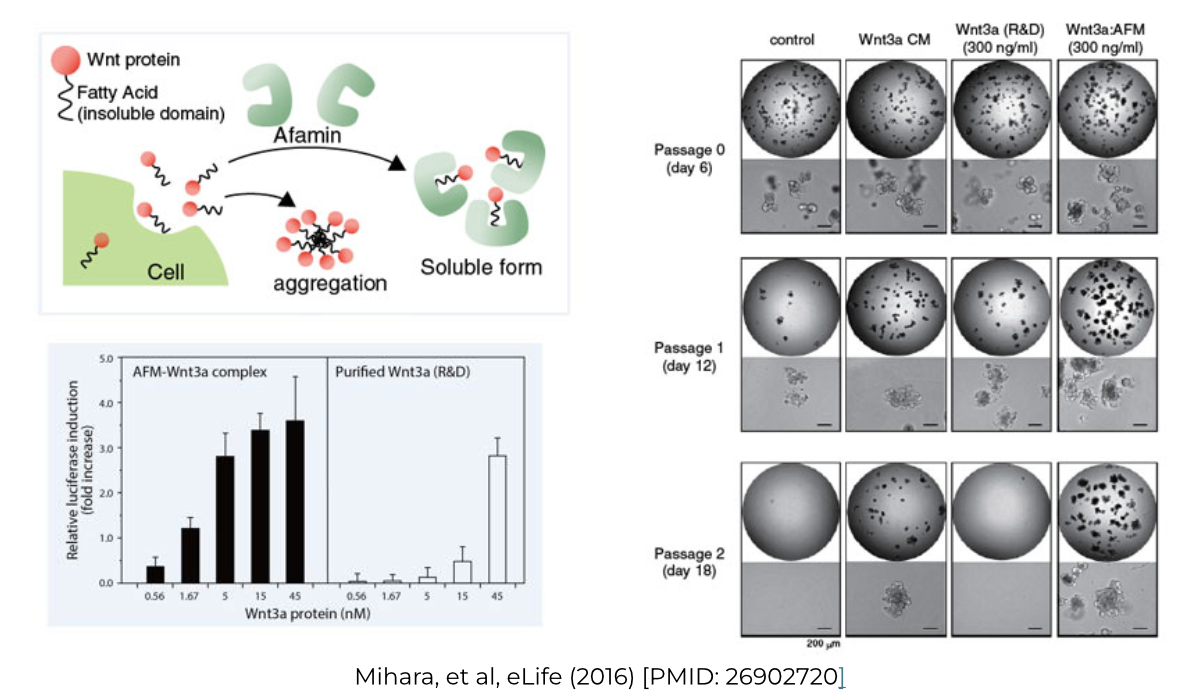
In 2016, Mihara et al. found that high Wnt3a activity can be maintained by forming a complex with Wnt3a by Afamin, which is one of the components of serum. In addition, by using Afamin and Wnt3a complex for organoid culture, long-term culture of organoids becomes possible.
MBL provides a stable and highly reactive Afamin/Wnt3a cell culture medium, which is also available in a high-concentration formulation. They also provide Recombinant Afamin/Wnt3a, which has been purified from the culture supernatant of CHO-K1 cells co-expressing Afamin and Wnt3a.
Mechanism of Wnt3a Stabilisation by Afamin Proteins
Afamin/Wnt3a CM increased LGR5 Positive Stem Cells
Images on the top panels show a bright field of human colour organoids. Images on the bottom panels show fluorescent LGR5-positive stem cells that express tdTomato, regulated by Lgr5 promoter. Afamin/Wnt3a CM-maintained LGR5 positive stem cell growth is seen at greater levels compared with cell growth in purified Wnt3a (300 ng/mL).
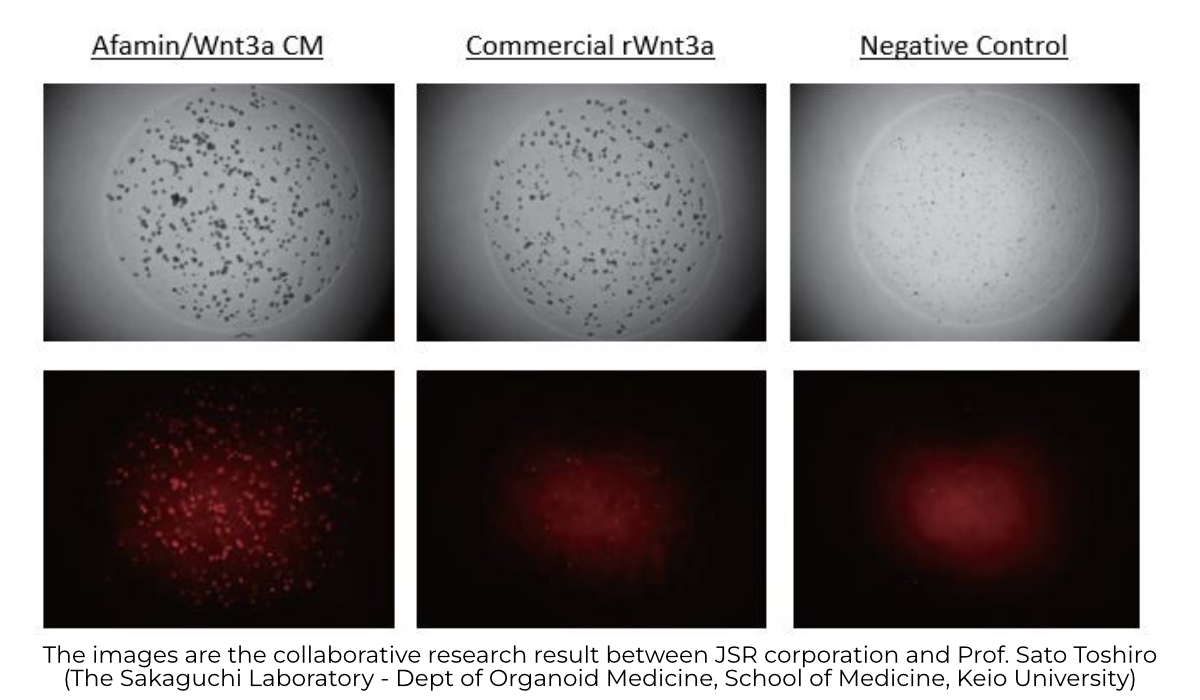
Recombinant Afamin/Wnt3a increased LGR5 Positive Stem Cells
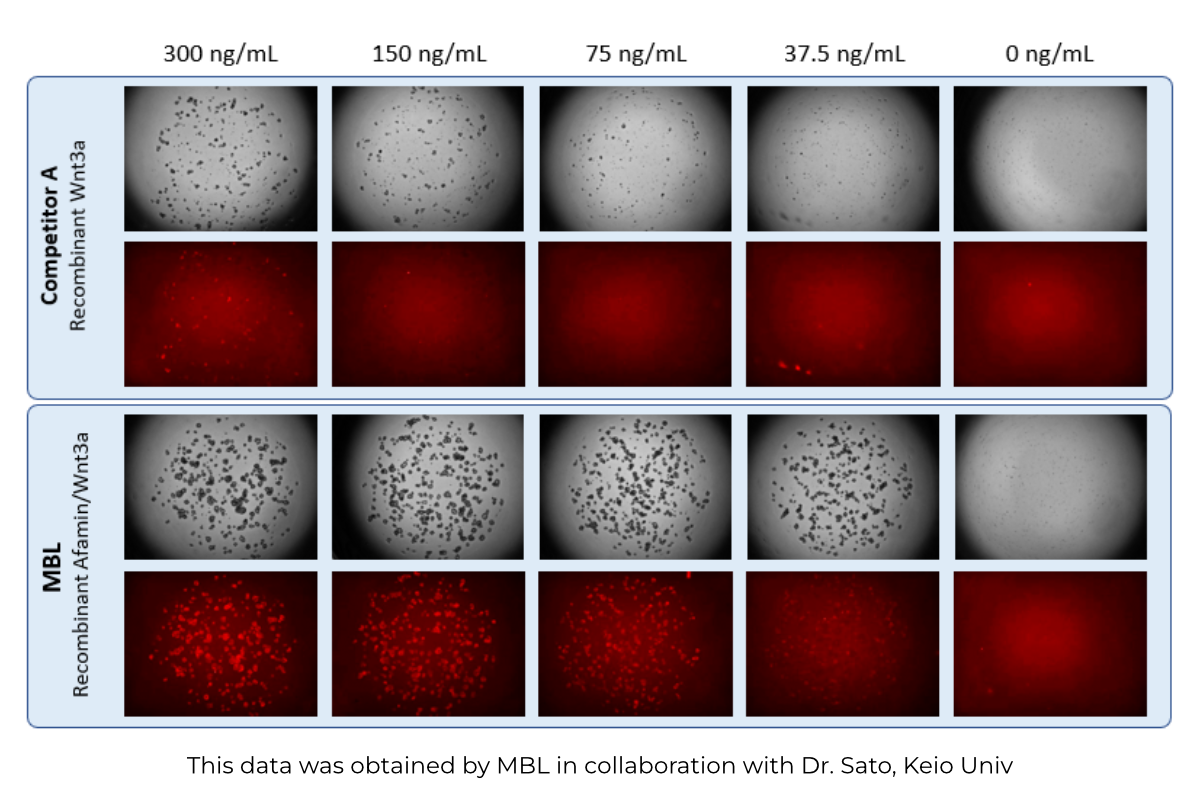
An organoid strain expressing tdTomato regulated by Lgr5 promoter was cultured in the presence of Recombinant Afamin/Wnt3a and Recombinant Wnt3a of competitor A. It was confirmed that Recombinant Afamin/Wnt3a maintains LGR5-positive cells even at low concentrations.
Recombinant Human R-spondin 1
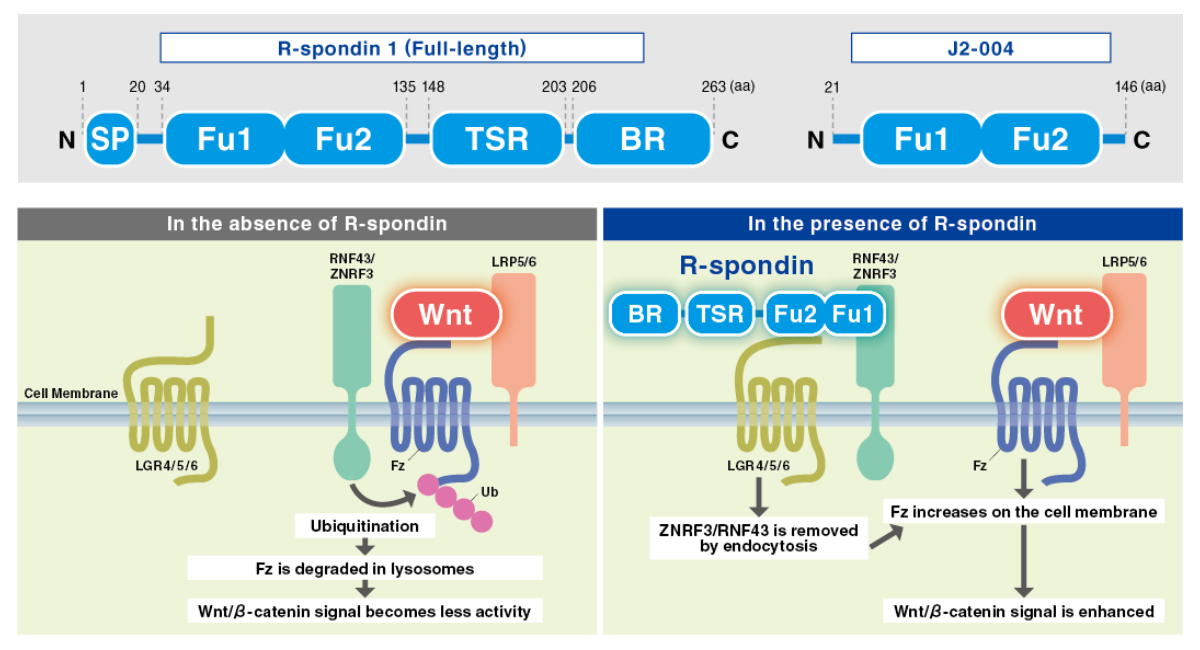
R-spondin 1 (roof plate-specific spondin 1), also known as Cristin 3, is one of the R-spondin family members that regulates the activation of canonical Wnt/β-catenin signalling. In the canonical Wnt/β-catenin signalling pathway, when Wnt binds to cell surface receptors Fz*1 and LRP5/6*2, intracellular β-catenin accumulates and activates the β-catenin pathway. However, in the absence of R-spondin, Fz is endocytosed by being ubiquitinated by the binding of the ubiquitin ligase RNF43*3/ZNRF3*4, Fz on the cell membrane decreases, and Wnt/β-catenin signals are not activated enough. Conversely, in the presence of R-spondin, RNF43/ZNRF3 forms trimers with LGRs*5 and R-spondin and is endocytosed, making it unable to ubiquitinate Fz. As a result, Fz on the cell membrane increases, and Wnt/β-catenin signals are strongly activated. 1)
Organoid culture typically utilises niche factors that act on Wnt, EGF, BMP and Notch signals that control stem cell differentiation. Among these signals, R-spondin 1 contributes to the activation of Wnt/β-catenin signals as described above.
MBL's Recombinant Human R-spondin 1 is a protein derived from the gene encoding human R-spondin 1 (region; 21-146 aa) expressed in E. coli. This region contains a bioactive fragment comprising the two cysteine-rich furin-like domains (Fu1 and Fu2). Fu1 binds to the extracellular domain of ZNRF3 and RNF43, and Fu2 binds to the extracellular domain of LGR4/5/6. 2)
*1 Frizzled, *2 low-density-lipoprotein receptor-related protein 5/6, *3 ring finger protein 43, *4 zinc and ring finger 3, *5 leucine-rich repeat-containing G-protein coupled receptors
FGF-Max
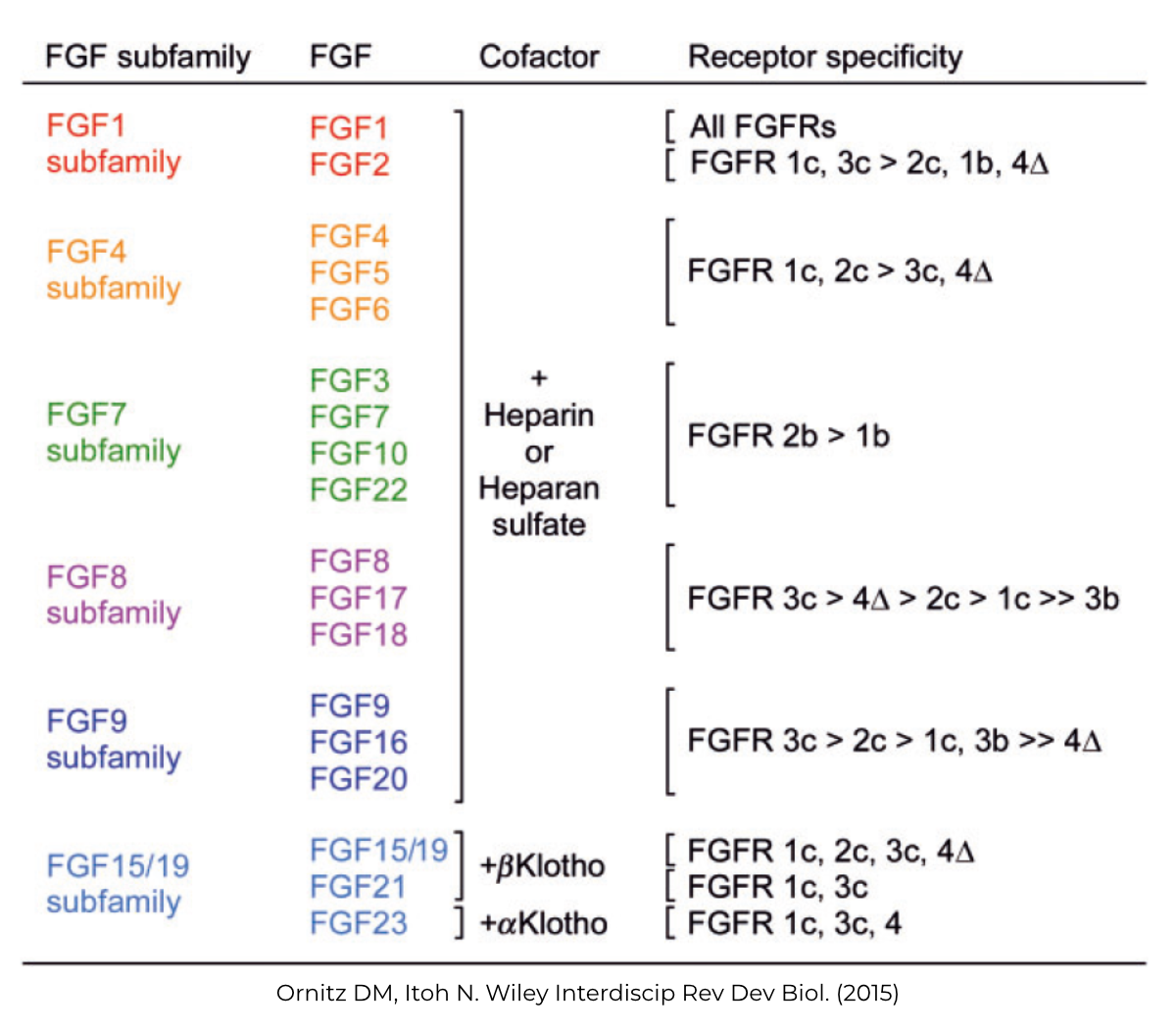
The family of fibroblast growth factors (FGFs) are composed of the growth factors involved in a variety of vital phenomena, including development, differentiation, proliferation, and morphogenesis. FGF-1 to FGF-10 transmit signals into cells by binding to the FGF receptor (FGFR).
Activation of the FGF/FGFR signalling pathway is known to be important in organoid cultures. However, proper selection of different FGFR ligands for each organ type is necessary, which complicates experimental setup and execution. Using the universal FGFR ligand “FGF-1”, which shows high affinity to all types of FGFR, is meant to be a simple and convenient method for organoid culture. However, FGF-1 is known to be thermally unstable and at 37°C, the temperature at which cell culture is normally conducted, the bio-activity is lost within 6 hours, even in the presence of heparin. These factors result in commercially available FGF1 being unsuitable for cell culture studies.
To solve the problem, MBL provides FGF-Max, a universal FGFR ligand which has enhanced thermal stability by chimerising FGF-1 and FGF-2.