

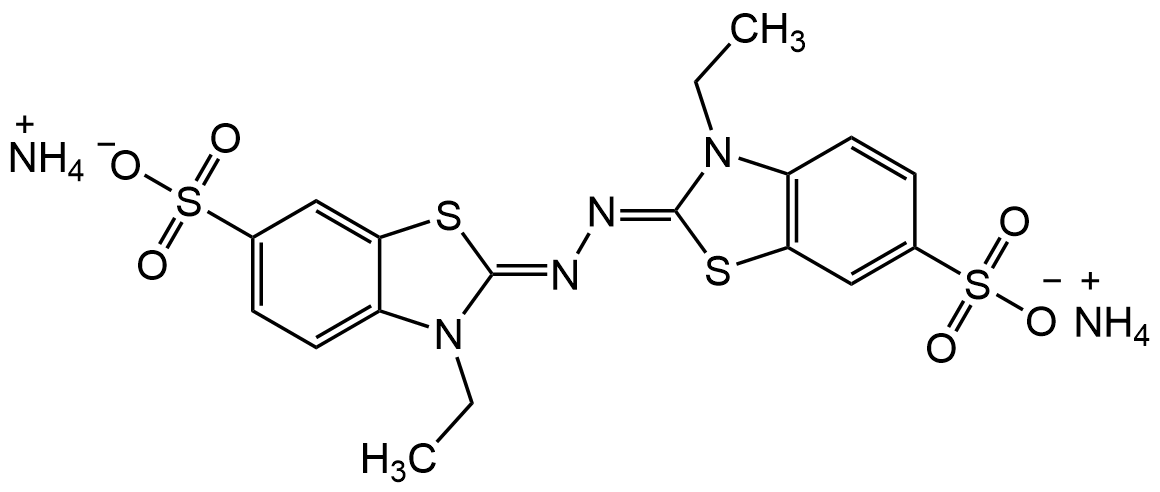
ABTS diammonium salt
Product Code:
CDX-A0591
CDX-A0591
Regulatory Status:
RUO
RUO
Shipping:
Ambient
Ambient
Storage:
Short term: +20°C. Long term: +4°C
Short term: +20°C. Long term: +4°C

No additional charges, what you see is what you pay! *
| Code | Size | Price |
|---|
| CDX-A0591-G001 | 1 g | £58.00 |
Quantity:
| CDX-A0591-G005 | 5 g | £197.00 |
Quantity:
Prices exclude any Taxes / VAT
Stay in control of your spending. These prices have no additional charges to UK mainland customers, not even shipping!
* Rare exceptions are clearly labelled (only 0.14% of items!).
* Rare exceptions are clearly labelled (only 0.14% of items!).
Multibuy discounts available! Contact us to find what you can save.
This product comes from: Switzerland.
Typical lead time: 7-10 working days.
Contact us for more accurate information.
Typical lead time: 7-10 working days.
Contact us for more accurate information.
- Further Information
- Documents
- References
- Show All
Further Information
Appearance:
Faint green to yellow powder.
CAS:
30931-67-0
Description:
ABTS (2,2' -Azino-bis-(3-ethylbenzothiazoline-6-sulfonic acid), diammonium salt) is a very sensitive chromogenic peroxidase substrate (including horseradish peroxidase (HRP)) widely used for ELISA applications. The substrate yields a water-soluble green colored product that can be quantified by colorimetric detection at 405 nm. The reaction may be stopped with 1% sodium dodecyl sulfate (SDS). It has commonly been used to assess antioxidant capacity in the Trolox equivalent antioxidant capacity (TEAC) assay. It has a blue color in the presence of sodium persulfate or metmyoglobin but decolorizes upon incubation with antioxidants, and the antioxidant capacity can be determined spectrophotometrically. ABTS is significantly used by the food industry, to measure the antioxidant capacities within different foods. ABTS is also used to monitor glucose concentrations in different solutions including blood serum and as a safe alternative to DAB for the enhancement of blood fingerprints.
EClass:
32160000
Form:
solid
Handling Advice:
Protect from light and moisture.
InChi:
InChI=1S/C18H18N4O6S4.2H3N/c1-3-21-13-7-5-11(31(23,24)25)9-15(13)29-17(21)19-20-18-22(4-2)14-8-6-12(32(26,27)28)10-16(14)30-18;;/h5-10H,3-4H2,1-2H3,(H,23,24,25)(H,26,27,28);2*1H3
InChiKey:
OHDRQQURAXLVGJ-AXMZSLBLSA-N
MDL:
MFCD00010404
Molecular Formula:
C18H16N4O6S4 . 2NH4
Molecular Weight:
548.68
Package Type:
Vial
Purity:
>98% (HPLC)
SMILES:
C(C)N1C=2C(SC1=NN=C3N(CC)C=4C(S3)=CC(S(=O)(=O)O)=CC4)=CC(S(=O)(=O)O)=CC2.N
Solubility Chemicals:
Soluble in water (10mg/ml) or DMSO (10mg/ml).
Source / Host:
Synthetic
Transportation:
Non-hazardous
UNSPSC Number:
41105331
Use & Stability:
Stable for at least 2 years after receipt when stored at +4°C.
Documents
References
(1) R.E. Childs & W.G. Bardsley; Biochem. J. 145, 93 (1975) | (2) N.P. Groome; J. Clin. Chem. Clin. Biochem. 18, 345 (1980) | (3) E. Engvall; Meth. Enzymol 70, 419 (1980) | (4) E. Al-Kaissi & A. Mostratos; J. Immunol. Methods. 58, 127 (1983) | (5) A. Szutowicz, et al.; Anal. Biochem. 138, 86 (1984) | (6) N.J. Miller & C.A. Rice-Evans; Free Radic. Res. 26, 195 (1997) | (7) J.P. Caldwell, et al.; J. Forensic Sci. 45, 785 (2000) | (8) D. Huang, et al.; J. Agric. Food Chem. 53, 1841 (2005) | (9) A. Reyna-Bello, et al.; J. Immunoassay Immunochem. 28, 1 (2007) | (10) R.B. Walker & J.D. Everette; J. Agric. Food Chem. 57, 1156 (2009) | (11) A.A. Salem, et al.; Anal. Chem. Insights 6, 37 (2011) | (12) Y. Li, et al.; Spectrochim. Acta A Mol. Biomol. Spectrosc. 173, 880 (2017) | (13) A. Liberato, et al.; Inorg. Chem. 57, 14471 (2018)