

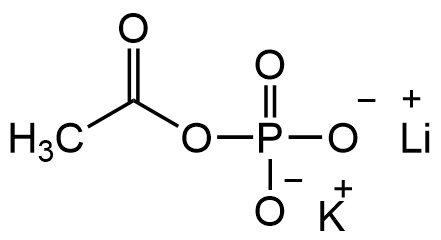
Acetyl phosphate lithium potassium
Product Code:
CDX-A0781
CDX-A0781
Regulatory Status:
RUO
RUO
Shipping:
Ambient
Ambient
Storage:
Short term: +4°C. Long term: -20°C
Short term: +4°C. Long term: -20°C

No additional charges, what you see is what you pay! *
| Code | Size | Price |
|---|
| CDX-A0781-M500 | 500 mg | £116.00 |
Quantity:
| CDX-A0781-G001 | 1 g | £180.00 |
Quantity:
Prices exclude any Taxes / VAT
Stay in control of your spending. These prices have no additional charges to UK mainland customers, not even shipping!
* Rare exceptions are clearly labelled (only 0.14% of items!).
* Rare exceptions are clearly labelled (only 0.14% of items!).
Multibuy discounts available! Contact us to find what you can save.
This product comes from: Switzerland.
Typical lead time: 7-10 working days.
Contact us for more accurate information.
Typical lead time: 7-10 working days.
Contact us for more accurate information.
- Further Information
- Documents
- References
- Show All
Further Information
Appearance:
White to off-white powder.
CAS:
94249-01-1
Description:
Lithium potassium acetyl phosphate is an organometallic compound that is used as a phosphoryl group donor. It is commonly used in protein phosphorylation reactions. Lithium potassium acetyl phosphate is suitable as a source of acetyl phosphate. It is suitable for reducing inorganic monophosphate by-product formation by replacing inorganic oligophosphates in phosphatase-catalyzed transphosphorylation. It is a energy-rich compound for the regeneration of adenosine-5'-triphosphate, ATP, and other triphosphates. Lithium potassium acetyl phosphate is also used in research focused on energy storage. This compound is studied for its potential applications in the development of battery materials, particularly those involving lithium-ion technology. Researchers explore Lithium potassium acetyl phosphate for its electrochemical properties, such as ion conductivity and stability, which are for improving battery performance and longevity.
EClass:
32160000
Form:
solid
GHS Symbol:
GHS05, GHS08
Handling Advice:
Keep under inert gas. Protect from light and oxygen.
Hazards:
H314-H361
InChi:
InChI=1S/C2H5O5P.K.Li/c1-2(3)7-8(4,5)6;;/h1H3,(H2,4,5,6);;/q;2*+1/p-2
InChiKey:
RLQMPLKXFIXRCV-UHFFFAOYSA-L
MDL:
MFCD00002134
Molecular Formula:
C2H3KLiO5P
Molecular Weight:
184.06
Package Type:
Vial
Precautions:
P201-P260-P280-P301+P330+P331-P303+P361+P353-P305+P351+P338+P310
Signal word:
Danger
SMILES:
[Li+].[K+].CC(=O)OP([O-])([O-])=O
Solubility Chemicals:
Soluble in water (25mg/ml).
Source / Host:
Synthetic
Transportation:
Excepted Quantity
UN Nummer:
UN3261
UNSPSC Number:
12352200
Use & Stability:
Stable for at least 2 years after receipt when stored at -20°C.
Documents
References
(1) W.R. Moore & A. Meister; Anal. Biochem. 161, 487 (1987) | (3) D.C. Crans, et al.; Meth. Enzymol. 136, 263 (1987) | (4) D. Janasek, et al.; Anal. Bioanal. Chem. 374, 1267 (2002) | (5) S. Mukhopadhyay, et al.; Bioorg. Chem. 36, 65 (2008) | (6) Y.H. Liu, et al.; J. Mol. Biol. 391, 149 (2009) | (7) Q. Chen, et al.; Bio. Protoc. 3, e970 (2013) | (8) B. Yan, et al.; World J. Microbiol. Biotechnol. 30, 1123 (2014) | (9) E. Kinoshita-Kikuta, et al.; PloS one 10, e0132598 (2015) | (10) G. Tasnadi, et al.; Adv. Synth. Catal. 360, 2394 (2018) | (11) A. Karami, et al: Front. Aging Neurosci. 13, 704583 (2021) | (12) E. Camprubi, et al.; Astrobiol. 22, 981 (2022)