

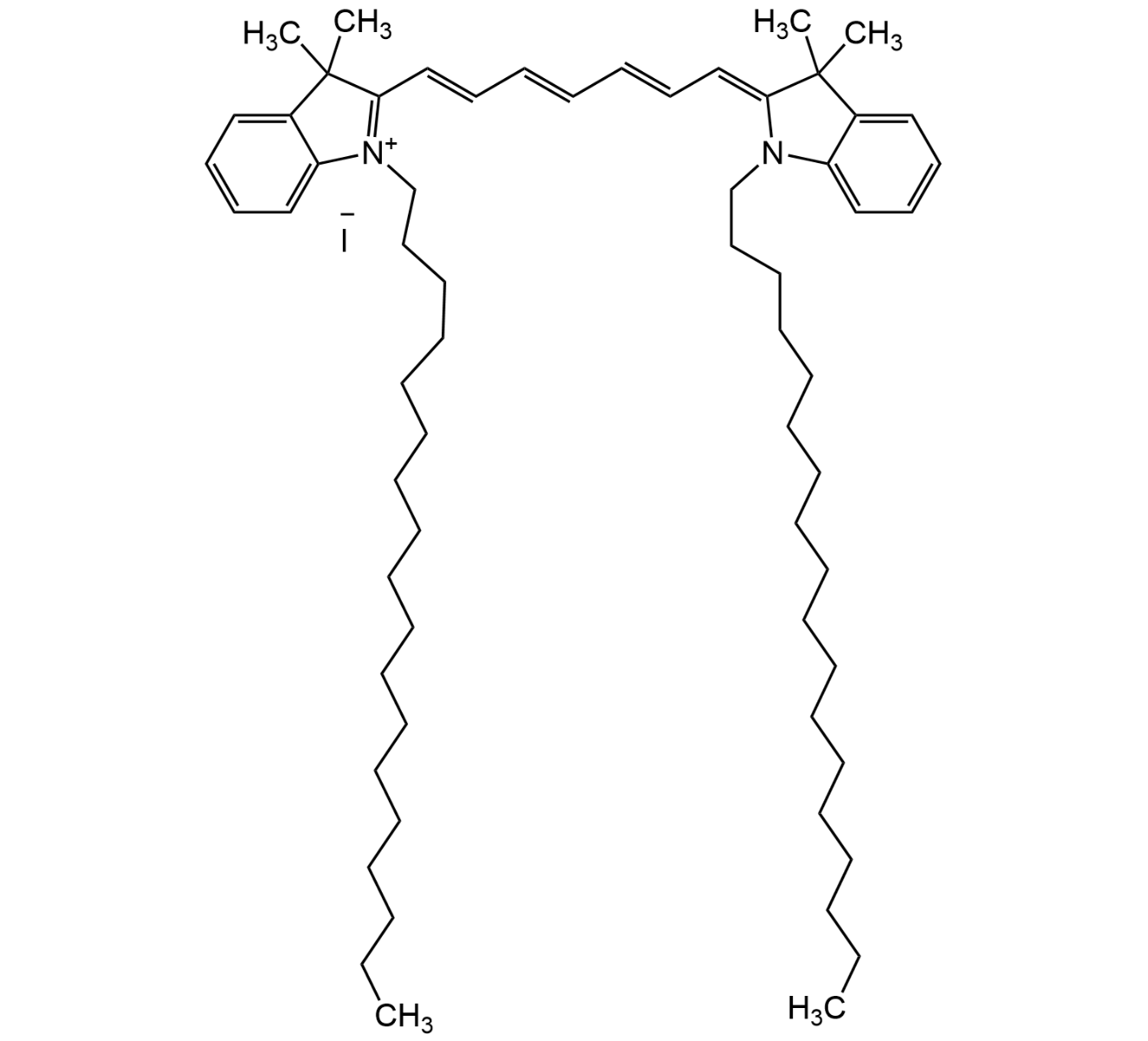
1,1'-Dioctadecyl-3,3,3',3'-tetramethyl indotricarbocyanine iodide
Product Code:
CDX-D1020
CDX-D1020
Regulatory Status:
RUO
RUO
Shipping:
Ambient
Ambient
Storage:
Short term: +4°C. Long term: -20°C
Short term: +4°C. Long term: -20°C

No additional charges, what you see is what you pay! *
| Code | Size | Price |
|---|
| CDX-D1020-M050 | 50 mg | £156.00 |
Quantity:
| CDX-D1020-M100 | 100 mg | £255.00 |
Quantity:
| CDX-D1020-M250 | 250 mg | £516.00 |
Quantity:
Prices exclude any Taxes / VAT
Stay in control of your spending. These prices have no additional charges to UK mainland customers, not even shipping!
* Rare exceptions are clearly labelled (only 0.14% of items!).
* Rare exceptions are clearly labelled (only 0.14% of items!).
Multibuy discounts available! Contact us to find what you can save.
This product comes from: Switzerland.
Typical lead time: 7-10 working days.
Contact us for more accurate information.
Typical lead time: 7-10 working days.
Contact us for more accurate information.
- Further Information
- Documents
- References
- Show All
Further Information
Appearance:
Dark purple solid.
CAS:
100068-60-8
Description:
DiIC18(7) [DiR] is a lipophilic, near-infrared fluorescent cyanine dye. The dye is useful for labeling cytoplasmic membranes and has been widely used for near-infrared in vivo imaging and for in vitro studies. The two long 18-carbon chains insert into the cell membrane, resulting in specific and stable cell staining with no or minimal dye transfer between cells. DiR diffuses laterally to stain the entire cell, allowing it to be used as an anterograde and retrograde tracer of neurons. In intact tissue, the dye does not transfer from labeled to unlabeled cells, but some transfer may occur when the membrane is disrupted, for example, after sectioning. Cell staining can be effected using the dye at 1-10 uM concentration and 10-20 min incubation time. The dye can be used for labeling nanoparticles and extracellular vescicles. The dye is weakly fluorescent until incorporated into membranes. Spectral Data: Excitation max: ~ 748nm, Emission max: ~780nm (MeOH).
EClass:
32160000
Form:
solid
GHS Symbol:
GHS07
Handling Advice:
Keep under inert gas. Protect from light and oxygen.
Hazards:
H315-H319-H335
InChi:
InChI=1S/C63H101N2.HI/c1-7-9-11-13-15-17-19-21-23-25-27-29-31-33-38-46-54-64-58-50-44-42-48-56(58)62(3,4)60(64)52-40-36-35-37-41-53-61-63(5,6)57-49-43-45-51-59(57)65(61)55-47-39-34-32-30-28-26-24-22-20-18-16-14-12-10-8-2;/h35-37,40-45,48-53H,7-34,38-39,46-47,54-55H2,1-6H3;1H/q+1;/p-1
InChiKey:
JLIOTPLALDYAEH-UHFFFAOYSA-M
MDL:
MFCD03427788
Molecular Formula:
C63H101N2 . I
Molecular Weight:
1013.4
Package Type:
Vial
Precautions:
P261-P264-P271-P280-P302+P352-P304+P340-P305+P351+P338-P312-P362-P403+P233-P501
Purity:
>97% (HPLC)
Signal word:
Warning
SMILES:
CC1(C)C2=C(C=CC=C2)N(CCCCCCCCCCCCCCCCCC)C1=CC=CC=CC=CC3=[N+](CCCCCCCCCCCCCCCCCC)C4=C(C3(C)C)C=CC=C4.[I-]
Solubility Chemicals:
Soluble in DMSO or methanol.
Source / Host:
Synthetic
Transportation:
Non-hazardous
UNSPSC Number:
41105331
Use & Stability:
Stable for at least 2 years after receipt when stored at -20°C.
Documents
References
(1) V. Kalchenko, et al.; J. Biomed. Opt. 11, 050507 (2006) | (2) M. Eisenblatter, et al.; J. Nucl. Med. 50, 1676 (2009) | (3) A. Wagh, et al.; ioconjug. Chem. 23, 981 (2012) | (4) H. Liu & D. Wu; Curr. Drug Deliv. 13, 40 (2016) | (5) M.T. Berninger, et al.; Eur. Radiol. 27, 1105 (2017) | (6) X. Zhang, et al.; ACS Appl. Mater. Interfaces 10, 30155 (2018) | (7) M. Riehl, et al.; Eur. J. Pharm. Sci. 132, 27 (2019) | (8) M. Bhogal, et al.; Sci. Rep. 12, 6338 (2022) | (9) J. Santelices, et al.; Bio. Protoc. 12, e4447 (2022)