
Chemodex

N-(3-Oxoheptanoyl)-L-homoserine lactone

Product Code:
 
CDX-O0138
Product Group:
 
Other Biochemicals
Supplier:
 
Chemodex
Regulatory Status:
 
RUO
Shipping:
 
Ambient
Storage:
 
Short term: +4°C. Long term: -20°C
1 / 1
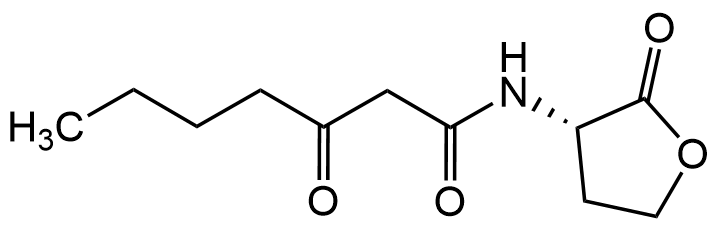
Chemical Structure

Chemical Structure

No additional charges, what you see is what you pay! *

CodeSizePrice
CDX-O0138-M01010 mg£79.00
Quantity:
CDX-O0138-M05050 mg£278.00
Quantity:
Prices exclude any Taxes / VAT
Stay in control of your spending. These prices have no additional charges to UK mainland customers, not even shipping!
* Rare exceptions are clearly labelled (only 0.14% of items!).
Multibuy discounts available! Contact us to find what you can save.
This product comes from: Switzerland.
Typical lead time: 7-10 working days.
Contact us for more accurate information.
  • Further Information
  • Documents
  • References
  • Show All

Further Information

Appearance:
White to off-white powder.
CAS:
148433-17-4
Description:
N-(3-Oxoheptanoyl)-L-homoserine lactone is a small diffusible signaling molecule and is a member of N-acyl-homoserine lactone family. N-acylhomoserine lactones (AHL) are involved in quorum sensing, controlling gene expression, and cellular metabolism. The diverse applications of this kind of molecule include regulation of virulence in general, infection prevention, and formation of biofilms.
EClass:
32160000
Form:
solid
GHS Symbol:
GHS07
Handling Advice:
Protect from light and moisture.
Hazards:
H302
InChi:
InChI=1S/C11H17NO4/c1-2-3-4-8(13)7-10(14)12-9-5-6-16-11(9)15/h9H,2-7H2,1H3,(H,12,14)/t9-/m0/s1
InChiKey:
WMGXONSYPOENKA-VIFPVBQESA-N
Molecular Formula:
C11H17NO4
Molecular Weight:
227.26
Package Type:
Vial
Purity:
>97% (HPLC)
Signal word:
Warning
SMILES:
CCCCC(=O)CC(=O)N[C@H]1CCOC1=O
Solubility Chemicals:
Soluble in DMSO.
Source / Host:
Synthetic
Transportation:
Non-hazardous
UNSPSC Number:
12352200
Use & Stability:
Stable for at least 2 years after receipt when stored at -20°C.

Documents

References

(1) C.F. Sio, et al.; Infect. Immun. 74, 1673 (2006) | (2) M. Horikawa, et al.; Bioorg. Med. Chem. Lett. 16, 2130 (2006) | (3) C.A. Ortori, et al.; Anal. Bioanal. Chem. 387, 497 (2007) | (4) V.G. Kastbjerg, et al.; J. Appl. Microbiol. 102, 363 (2007) | (5) A.G. Palmer, et al.; ChemBioChem 12, 138 (2011) | (6) M. Syrpas, et al.; Mar. Drugs 12, 352 (2014)