

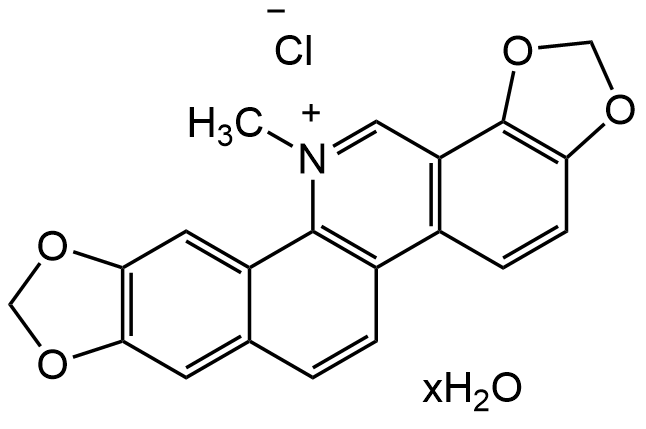
Sanguinarine chloride hydrate
Product Code:
CDX-S0377
CDX-S0377
Regulatory Status:
RUO
RUO
Shipping:
Ambient
Ambient
Storage:
Short term: +20°C. Long term: +4°C
Short term: +20°C. Long term: +4°C

No additional charges, what you see is what you pay! *
| Code | Size | Price |
|---|
| CDX-S0377-M010 | 10 mg | £162.00 |
Quantity:
| CDX-S0377-M050 | 50 mg | £470.00 |
Quantity:
Prices exclude any Taxes / VAT
Stay in control of your spending. These prices have no additional charges to UK mainland customers, not even shipping!
* Rare exceptions are clearly labelled (only 0.14% of items!).
* Rare exceptions are clearly labelled (only 0.14% of items!).
Multibuy discounts available! Contact us to find what you can save.
This product comes from: Switzerland.
Typical lead time: 7-10 working days.
Contact us for more accurate information.
Typical lead time: 7-10 working days.
Contact us for more accurate information.
- Further Information
- Documents
- References
- Show All
Further Information
Appearance:
Faint orange to dark orange powder.
CAS:
5578-73-4
Description:
Sanguinarine chloride is a quaternary ammonium benzophenanthine alkaloid found in traditional herbs such as Chelidonium, Corydalis, Sanguinarum, and Borovula. It has been proven to possess broad-spectrum biological activities, such as antitumor, anti-inflammatory, antiosteoporosis, neuroprotective, immune regulatory, cardiovascular, antibacterial, antiviral and antiparasitic activities. Sanguinarine chloride is an inhibitor of protein phosphatase 2C (PP2C), selective over PP1, PP2A and PP2B in vitro. It inhibits mitogen-activated protein kinase phosphatase-1 (MKP-1), JNK, MAPK, NF-kB, STAT3, MMP-2, MMP-9 and other kinases. Sanguinarine chloride blocks cell cycle in the G1 phase, stimulates apoptosis via induction of reactive oxygen species (ROS), disrupts the microtubule assembly and causes DNA damage resulting the death of the cancer cells.
EClass:
32160000
Form:
solid
GHS Symbol:
GHS07
Handling Advice:
Protect from light and moisture.
Hazards:
H302
InChi:
InChI=1S/C20H14NO4.ClH.H2O/c1-21-8-15-12(4-5-16-20(15)25-10-22-16)13-3-2-11-6-17-18(24-9-23-17)7-14(11)19(13)21;;/h2-8H,9-10H2,1H3;1H;1H2/q+1;;/p-1
InChiKey:
XJCOXSCAMNPLFI-UHFFFAOYSA-M
MDL:
MFCD03788211
Molecular Formula:
C20H14ClNO4 . xH2O
Molecular Weight:
367.78 (anhydrous basis)
Package Type:
Vial
Precautions:
P264-P270-P301+P312-P501
Purity:
>98% (HPLC)
Signal word:
Warning
SMILES:
C[N+]1=CC2=C(C=CC3=C2OCO3)C4=C1C5=CC(OCO6)=C6C=C5C=C4.[Cl-]
Solubility Chemicals:
Soluble in DMSO (3mg/ml).
Source / Host:
Semisynthetic
Transportation:
Non-hazardous
UNSPSC Number:
12352200
Use & Stability:
Stable for at least 2 years after receipt when stored at -20°C.
Documents
References
(1) K.C. Godowski; J. Clin. Dent. 1, 96 (1989) (Review) | (2) M.M. Chaturvedi, et al.; J. Biol. Chem. 272, 30129 (1997) | (3) A. Vogt, et al; J. Biol. Chem. 280, 19078 (2005) | (4) N. Aburai, et al; Biosci. Biotechnol. Biochem. 74, 548 (2010) | (5) M.H. Han, et al.; Toxicol. Lett. 220, 157 (2013) | (6) S. Pallichankandy, et al.; Free Redic. Biol. Med. 89, 708 (2015) | (7) P. Basu & G.S. Kumar; Adv. Exp. Med. Biol. 928, 155 (2016) (Review) | (8) I.W. Achkar, et al.; Future Med. Chem. 9, 933 (2017) (Review) | (9) S. Galadari, et al.; Phytomed. 34, 143 (2017) (Review) | (10) L.J. Huang, et al.; Biomed. Pharmacother. 173, 116406 (2024) (Review)