

Oral Keratinocyte Medium
Product Code:
SC-2611
SC-2611
Product Group:
Cell Culture Media
Cell Culture Media
Supplier:
Sciencell
Sciencell
Regulatory Status:
RUO
RUO
Product Types:
- Complete
- Kits and Bundles
Shipping:
Dry Ice
Dry Ice

No additional charges, what you see is what you pay! *
Stay in control of your spending. These prices have no additional charges to UK mainland customers, not even shipping!
* Rare exceptions are clearly labelled (only 0.14% of items!).
* Rare exceptions are clearly labelled (only 0.14% of items!).
Multibuy discounts available! Contact us to find what you can save.
This product comes from: United States.
Typical lead time: 10-14 working days.
Contact us for more accurate information.
Typical lead time: 10-14 working days.
Contact us for more accurate information.
- Further Information
- Documents
- References
- Related Products
- Show All
Further Information
Components:
Complete kit (includes supplements)
Description:
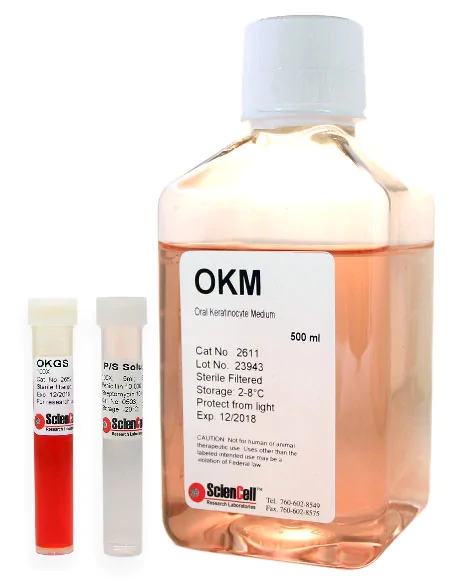
Oral Keratinocyte Medium (OKM), when used with Oral Keratinocyte Growth Supplement (OKGS, Cat #2652), is a complete medium designed for optimal growth of normal oral keratinocytes in vitro. It is a sterile, liquid medium which contains essential and non-essential amino acids, vitamins, organic and inorganic compounds, hormones, growth factors and trace minerals. The medium is HEPES and bicarbonate buffered and has a pH of 7.4 when equilibrated in an incubator with an atmosphere of 5% CO2/95% air. The medium is formulated (quantitatively and qualitatively) to provide an optimally balanced nutritional environment that selectively supports the growth of normal oral keratinocytes in vitro.
Extra Description:
OKM consists of 500 ml of basal medium, 5 ml of oral keratinocyte growth supplement (OKGS, Cat. No. 2652) and 5 ml of Antibiotic solution (P/S, Cat. No. 0503).
Documents
References
- https://journals.plos.org/plosone/article?id=10.1371/journal.pone.0063295
- https://pubmed.ncbi.nlm.nih.gov/24079913/
- https://molecular-cancer.biomedcentral.com/articles/10.1186/1476-4598-12-68
- https://journals.plos.org/plosone/article?id=10.1371/journal.pone.0067985
- https://researchoutput.ncku.edu.tw/en/publications/reciprocal-regulation-of-microrna-99a-and-insulin-like-growth-fac
- https://www.ncbi.nlm.nih.gov/pmc/articles/PMC3875575/
- http://www.ncbi.nlm.nih.gov/pmc/articles/PMC4820737/pdf/jcav07p0600.pdf
- http://www.ncbi.nlm.nih.gov/pmc/articles/PMC4694824/pdf/oncotarget-06-25188.pdf
- http://www.ncbi.nlm.nih.gov/pmc/articles/PMC4594676/pdf/jcmm0019-2341.pdf
- http://www.ncbi.nlm.nih.gov/pmc/articles/PMC4396206/pdf/ijcep0008-1364.pdf
- http://www.ncbi.nlm.nih.gov/pmc/articles/PMC4359265/pdf/oncotarget-06-915.pdf
- https://www.ncbi.nlm.nih.gov/pmc/articles/PMC4399078/
- http://journals.plos.org/plosone/article/asset?id=10.1371/journal.pone.0142252.PDF
- http://journals.plos.org/plosone/article/asset?id=10.1371/journal.pone.0137923.PDF
- http://journals.plos.org/plosone/article/asset?id=10.1371/journal.pone.0152526.PDF
- https://www.ncbi.nlm.nih.gov/pmc/articles/PMC4937741/pdf/ajcr00061396.pdf
Related Products
| Product Name | Product Code | Supplier | Penicillin/Streptomycin Solution | SC-0503 | Sciencell | Summary Details | |||||||||||||||||||||||||||||||||||||||||||||||||||||||||||||||||||||||||||||||||||||||||||||
|---|---|---|---|---|---|---|---|---|---|---|---|---|---|---|---|---|---|---|---|---|---|---|---|---|---|---|---|---|---|---|---|---|---|---|---|---|---|---|---|---|---|---|---|---|---|---|---|---|---|---|---|---|---|---|---|---|---|---|---|---|---|---|---|---|---|---|---|---|---|---|---|---|---|---|---|---|---|---|---|---|---|---|---|---|---|---|---|---|---|---|---|---|---|---|---|---|---|---|---|
| Oral Keratinocyte Medium-basal | SC-2611-b | Sciencell | Summary Details | ||||||||||||||||||||||||||||||||||||||||||||||||||||||||||||||||||||||||||||||||||||||||||||||||
| Oral Keratinocyte Medium-basal-phenol red free | SC-2611-b-prf | Sciencell | Summary Details | ||||||||||||||||||||||||||||||||||||||||||||||||||||||||||||||||||||||||||||||||||||||||||||||||
| Oral Keratinocyte Medium-phenol red free | SC-2611-prf | Sciencell | Summary Details | ||||||||||||||||||||||||||||||||||||||||||||||||||||||||||||||||||||||||||||||||||||||||||||||||
| Oral Keratinocyte Growth Supplement | SC-2652 | Sciencell | Summary Details | ||||||||||||||||||||||||||||||||||||||||||||||||||||||||||||||||||||||||||||||||||||||||||||||||