

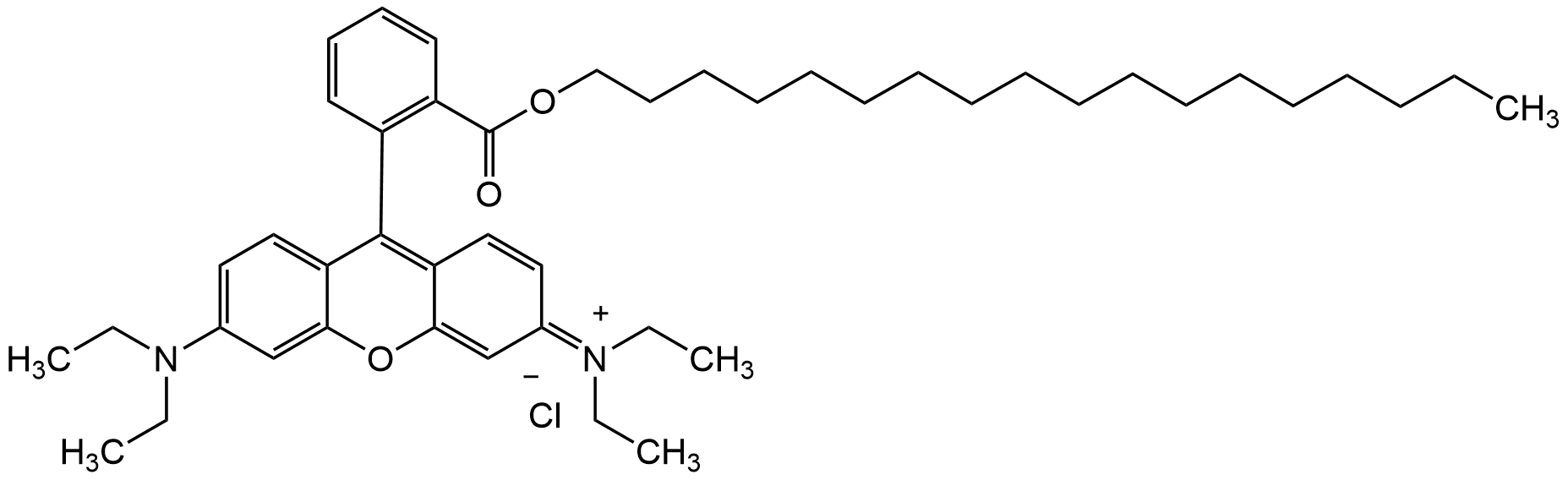
Octadecyl Rhodamine B chloride
Product Code:
CDX-O0014
CDX-O0014
Product Group:
Dyes, Stains, and Probes
Dyes, Stains, and Probes
Supplier:
Chemodex
Chemodex
Regulatory Status:
RUO
RUO
Shipping:
Ambient
Ambient
Storage:
Short term: +4°C. Long term: -20°C
Short term: +4°C. Long term: -20°C

No additional charges, what you see is what you pay! *
Stay in control of your spending. These prices have no additional charges to UK mainland customers, not even shipping!
* Rare exceptions are clearly labelled (only 0.14% of items!).
* Rare exceptions are clearly labelled (only 0.14% of items!).
Multibuy discounts available! Contact us to find what you can save.
This product comes from: Switzerland.
Typical lead time: 7-10 working days.
Contact us for more accurate information.
Typical lead time: 7-10 working days.
Contact us for more accurate information.
- Further Information
- Documents
- References
- Show All
Further Information
Appearance:
Red solid.
CAS:
65603-19-2
Description:
Octadecyl Rhodamine B chloride (R18) is a lipophilic fluorescent dye widely used in membrane biology and cell labeling studies. R18 is used in dequenching assays to monitor liposome fusion or virus-cell membrane fusion. It incorporates into plasma membranes for cell tracking, membrane dynamics, or cell-cell interaction studies. It can be used to label synthetic vesicles to study endocytosis, drug delivery, or membrane trafficking. R18 has also been used as acceptor in FRET studies on liposomes. The fluorescence of octadecyl rhodamine B in membranes is quenched at high dye concentration but is released at dilution. This property makes the dye useful for membrane fusion assays. Spectral Data: lambdaEx/lambdaEm (MeOH) = 556/580nm.
EClass:
32160000
Form:
solid
GHS Symbol:
GHS07
Handling Advice:
Protect from light and moisture.
Hazards:
H315-H319-H335
InChi:
InChI=1S/C46H67N2O3.ClH/c1-6-11-12-13-14-15-16-17-18-19-20-21-22-23-24-27-34-50-46(49)40-29-26-25-28-39(40)45-41-32-30-37(47(7-2)8-3)35-43(41)51-44-36-38(31-33-42(44)45)48(9-4)10-5;/h25-26,28-33,35-36H,6-24,27,34H2,1-5H3;1H/q+1;/p-1
InChiKey:
NFGODEMQGQNUKK-UHFFFAOYSA-M
MDL:
MFCD00467892
Molecular Formula:
C46H67ClN2O3
Molecular Weight:
731.5
Package Type:
Vial
Precautions:
P261-P305+P351+P338-P302+P352
Purity:
>95% (TLC)
Signal word:
Warning
SMILES:
CCCCCCCCCCCCCCCCCCOC(=O)C1=CC=CC=C1C2=C3C=CC(=[N+](CC)CC)C=C3OC4=C2C=CC(=C4)N(CC)CC.[Cl-]
Solubility Chemicals:
Soluble in ethanol (10mg/ml) or DMSO.
Source / Host:
Synthetic
Transportation:
Non-hazardous
UNSPSC Number:
41105331
Use & Stability:
Stable for at least 2 years after receipt when stored at -20°C.
Documents
References
(1) D. Hoekstra, et al.; Biochem. 23, 5675 (1984) | (2) A. Stutzin, et al.; FEBS Lett. 197, 274 (1986) | (3) D. Hoekstra & K. Klappe K; Biosci. Rep. 6, 953 (1986) | (4) S. Tomlinson, et al.; Biochem. 28, 8303 (1989) | (5) L. Corazzi, et al.; J. Membr. Biol. 112, 123 (1989) | (6) J. Arnhold, et al.; Biochim. Biophys. Acta 1191, 375 (1994) | (7) T. Reda, et al.; Mol. Membr. Biol. 12, 271 (1995) | (8) H. Hyogo, et al.; Dig. Dis. Sci. 44, 1662 (1999) | (9) A.A. Vallejo & M.S. Fernandez; Arch. Biochem. Biophys. 480, 1 (2008) | (10) I. Trikash, et al.; Chem. Phys. Lipids 163, 778 (2010) | (11) T. Tian, et al.; J. Cell Physiol. 228, 1487 (2013) | (12) Y.M.D. Gnopo & D. Putnam; Methods 177, 74 (2020)