

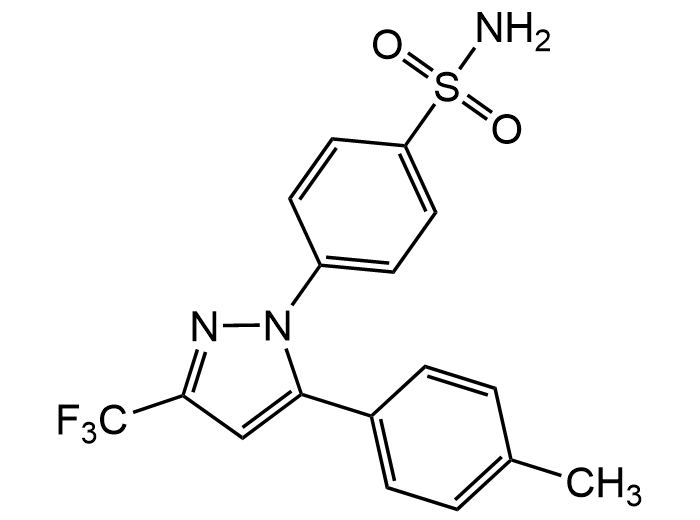
Celecoxib
Product Code:
CDX-C0439
CDX-C0439
Product Group:
Other Biochemicals
Other Biochemicals
Supplier:
Chemodex
Chemodex
Regulatory Status:
RUO
RUO
Shipping:
Ambient
Ambient
Storage:
Short term: +20°C. Long term: +4°C.
Short term: +20°C. Long term: +4°C.

No additional charges, what you see is what you pay! *
Stay in control of your spending. These prices have no additional charges to UK mainland customers, not even shipping!
* Rare exceptions are clearly labelled (only 0.14% of items!).
* Rare exceptions are clearly labelled (only 0.14% of items!).
Multibuy discounts available! Contact us to find what you can save.
This product comes from: Switzerland.
Typical lead time: 7-10 working days.
Contact us for more accurate information.
Typical lead time: 7-10 working days.
Contact us for more accurate information.
- Further Information
- Documents
- References
- Show All
Further Information
Appearance:
White to beige powder.
CAS:
169590-42-5
EClass:
32160000
Form:
solid
GHS Symbol:
GHS08, GHS09
Handling Advice:
Protect from light and moisture.
Hazards:
H360D-H373-H410
InChi:
InChI=1S/C17H14F3N3O2S/c1-11-2-4-12(5-3-11)15-10-16(17(18,19)20)22-23(15)13-6-8-14(9-7-13)26(21,24)25/h2-10H,1H3,(H2,21,24,25)
InChiKey:
RZEKVGVHFLEQIL-UHFFFAOYSA-N
Long Description:
Chemical. CAS: 169590-42-5. Formula: C17H14F3N3O2S. MW: 381.37. Celecoxib is a nonsteroidal anti-inflammatory drug (NSAID) and a highly selective cyclooxygenase-2 (COX-2) inhibitor. By preferentially inhibiting COX-2 over COX-1, celecoxib suppresses the formation of pro-inflammatory prostaglandins while minimizing effects on gastric COX-1 activity. It is widely used as a pharmacological tool in inflammation, pain, cancer, and cardiovascular research. In addition to its well-established anti-inflammatory mechanism, celecoxib has been shown to exert COX-2-independent biological effects, including induction of apoptosis, modulation of Bcl-2 family proteins, and regulation of ion channel activity. These properties make celecoxib a widely used research tool in inflammation, oncology, and cell-death signaling studies.
MDL:
MFCD00941298
Molecular Formula:
C17H14F3N3O2S
Molecular Weight:
381.37
Package Type:
Vial
PG:
III
Precautions:
P202-P260-P273-P280-P308+P313-P391
Product Description:
Celecoxib is a nonsteroidal anti-inflammatory drug (NSAID) and a highly selective cyclooxygenase-2 (COX-2) inhibitor. By preferentially inhibiting COX-2 over COX-1, celecoxib suppresses the formation of pro-inflammatory prostaglandins while minimizing effects on gastric COX-1 activity. It is widely used as a pharmacological tool in inflammation, pain, cancer, and cardiovascular research. In addition to its well-established anti-inflammatory mechanism, celecoxib has been shown to exert COX-2-independent biological effects, including induction of apoptosis, modulation of Bcl-2 family proteins, and regulation of ion channel activity. These properties make celecoxib a widely used research tool in inflammation, oncology, and cell-death signaling studies.
Purity:
>98% (HPLC)
Signal word:
Danger
SMILES:
O=S(=O)(N)C1=CC=C(C=C1)N2N=C(C=C2C=3C=CC(=CC3)C)C(F)(F)F
Solubility Chemicals:
Soluble in DMSO (15mg/ml), DMF (25mg/ml) or ethanol (25mg/ml). Insoluble in water.
Transportation:
Excepted Quantity
UN Nummer:
UN3077
UNSPSC Category:
Biochemical Reagents
UNSPSC Number:
12352200
Use & Stability:
Stable for at least 2 years after receipt when stored at +4°C.
Documents
References
[1] M.M. Goldenberg; Clin. Ther. 21, 1497 (1999) (Review) | [2] N.M. Davies, et al.; Clin. Pharmacokinet. 38, 225 (2000) (Review) | [3] D. Clemett & K.L. Goa; Drugs 59, 957 (2000) (Review) | [4] I.A. Mardini & G.A. Fitzgerald; Mol. Interv. 1, 30 (2001) | [5] A.T. Koki & J.L. Masferrer; Cancer Control 9, 28 (2002) (Review) | [6] V. Jendrossek, et al.; FASEB J. 17, 1547 (2003) | [7] K. Kismet, et al.; Cancer Detect. Prev. 28, 127 (2004) (Review) | [8] D. Jiang, et al.;Int. J. Mol. Sci. 11, 4106 (2010) | [9] K. Antoniou, et al.; Expert Opin. Pharmacother. 8, 1719 (2007) (Review) | [10] L.L. Winfield & F. Payton-Stewart; Future Med. Chem. 4, 361 (2012) (Review) | [11] V. Jendrossek; Cancer Lett. 332, 313 (2013) (Review) | [12] R.V. Frolov & S. Singh; Eur. J. Pharmacol. 730, 61 (2014) (Review) | [13] A.F. Khafaga, et al.; Nanomedicine 16, 1691 (2021) (Review)