

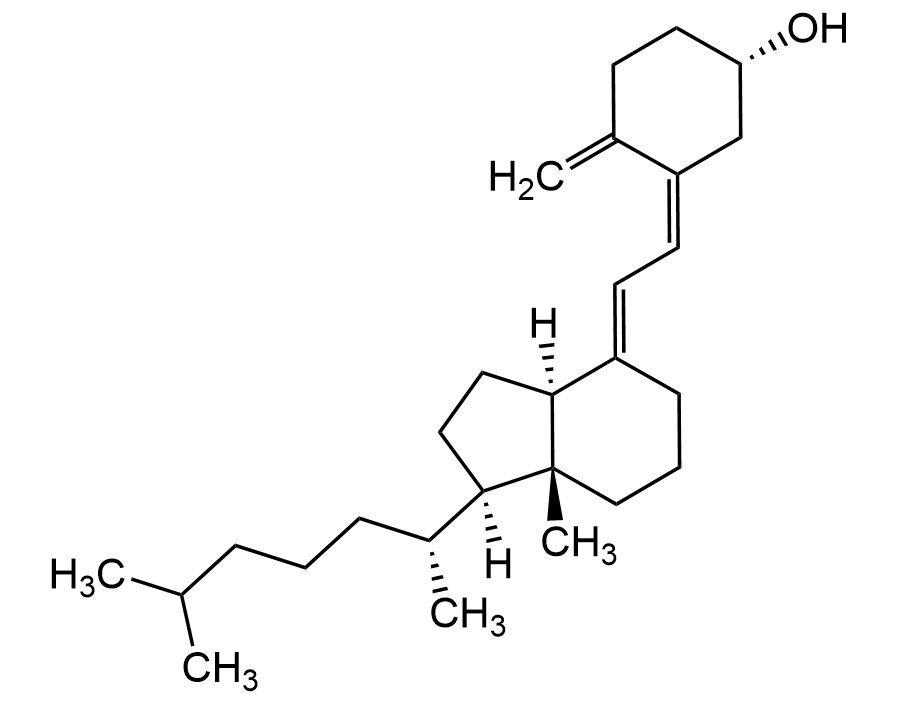
Cholecalciferol
Product Code:
CDX-C0668
CDX-C0668
Product Group:
Other Biochemicals
Other Biochemicals
Supplier:
Chemodex
Chemodex
Regulatory Status:
RUO
RUO
Shipping:
Ambient
Ambient
Storage:
Short term: +20°C. Long term: +4°C.
Short term: +20°C. Long term: +4°C.

No additional charges, what you see is what you pay! *
Stay in control of your spending. These prices have no additional charges to UK mainland customers, not even shipping!
* Rare exceptions are clearly labelled (only 0.14% of items!).
* Rare exceptions are clearly labelled (only 0.14% of items!).
Multibuy discounts available! Contact us to find what you can save.
This product comes from: Switzerland.
Typical lead time: 7-10 working days.
Contact us for more accurate information.
Typical lead time: 7-10 working days.
Contact us for more accurate information.
- Further Information
- Documents
- References
- Show All
Further Information
Appearance:
White to off white powder.
CAS:
67-97-0
EClass:
32160000
Form:
solid
GHS Symbol:
GHS06, GHS08
Handling Advice:
Protect from light and moisture.
Hazards:
H301+H311-H330-H372
InChi:
InChI=1S/C27H44O/c1-19(2)8-6-9-21(4)25-15-16-26-22(10-7-17-27(25,26)5)12-13-23-18-24(28)14-11-20(23)3/h12-13,19,21,24-26,28H,3,6-11,14-18H2,1-2,4-5H3/b22-12+,23-13-/t21-,24+,25-,26+,27-/m1/s1
InChiKey:
QYSXJUFSXHHAJI-YRZJJWOYSA-N
Long Description:
Chemical. CAS: 67-97-0. Formula: C27H44O. MW: 384.64. Cholecalciferol (Vitamin D3) is a naturally occurring secosteroid and a key precursor in the vitamin D metabolic pathway. This inactive precursor to calcitriol (Vitamin D) is converted to active metabolites in vivo. Following hydroxylation in vivo, cholecalciferol is converted to biologically active Vitamin D metabolites that interact with the vitamin D receptor (VDR) to regulate gene expression. Cholecalciferol is widely used in biochemical, cell culture, and metabolic research to study Vitamin D signaling, calcium homeostasis, and endocrine regulation. Formulations containing Vitamin D3 have been used in the treatment of osteoporosis. Cholecalciferol (Vitamin D3) appears to stimulate the body's interferon type I signaling system that protects against bacteria and viruses.
MDL:
MFCD00078131
Molecular Formula:
C27H44O
Molecular Weight:
384.64
Package Type:
Vial
PG:
II
Precautions:
P280-P301+P310+P330-P302+P352+P312-P304+P340+P310-P314
Product Description:
Cholecalciferol (Vitamin D3) is a naturally occurring secosteroid and a key precursor in the vitamin D metabolic pathway. This inactive precursor to calcitriol (Vitamin D) is converted to active metabolites in vivo. Following hydroxylation in vivo, cholecalciferol is converted to biologically active Vitamin D metabolites that interact with the vitamin D receptor (VDR) to regulate gene expression. Cholecalciferol is widely used in biochemical, cell culture, and metabolic research to study Vitamin D signaling, calcium homeostasis, and endocrine regulation. Formulations containing Vitamin D3 have been used in the treatment of osteoporosis. Cholecalciferol (Vitamin D3) appears to stimulate the body's interferon type I signaling system that protects against bacteria and viruses.
Signal word:
Danger
SMILES:
C[C@@]12[C@](C(=CC=C3/C(=C)CC[C@H](O)C3)CCC1)(CC[C@@]2([C@@H](CCCC(C)C)C)[H])[H]
Solubility Chemicals:
Soluble in DMSO (2mg/ml), ethanol (25mg/ml), DMF (25mg/ml) or chloroform.
Transportation:
Excepted Quantity
UN Nummer:
UN2811
UNSPSC Category:
Biochemical Reagents
UNSPSC Number:
12352200
Use & Stability:
Stable for at least 2 years after receipt when stored at +4°C.
Documents
References
[1] T.C. Chen, et al.; Arch. Biochem. Biophys. 460, 213 (2007) | [2] M.F. Holick; N. Engl. J. Med. 357, 266 (2007) | [3] C.J. Rosen; N. Engl. J. Med. 364, 248 (2011) | [4] R. Wickham; J. Adv. Pract. Oncol. 3, 249 (2012) (Review) | [5] E. Zoico, et al.; Endocrinol. 155, 4178 (2014) | [6] R. Vieth; Eur. J. Clin. Nutr. 74, 1493 (2020) (Review) | [7] E. Ortiz-Prado, et al.; Front. Nutr. 12, 1579957 (2025) (Review)