

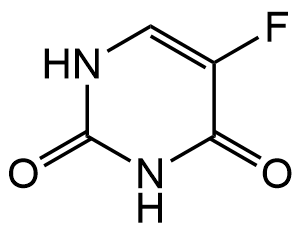
Fluorouracil
Product Code:
CDX-F0140
CDX-F0140
Product Group:
Other Biochemicals
Other Biochemicals
Supplier:
Chemodex
Chemodex
Regulatory Status:
RUO
RUO
Shipping:
Ambient
Ambient
Storage:
Short term: +20°C. Long term: +4°C.
Short term: +20°C. Long term: +4°C.

No additional charges, what you see is what you pay! *
Stay in control of your spending. These prices have no additional charges to UK mainland customers, not even shipping!
* Rare exceptions are clearly labelled (only 0.14% of items!).
* Rare exceptions are clearly labelled (only 0.14% of items!).
Multibuy discounts available! Contact us to find what you can save.
This product comes from: Switzerland.
Typical lead time: 7-10 working days.
Contact us for more accurate information.
Typical lead time: 7-10 working days.
Contact us for more accurate information.
- Further Information
- Documents
- References
- Show All
Further Information
Appearance:
White to off-white powder.
CAS:
51-21-8
EClass:
32160000
Form:
solid
GHS Symbol:
GHS06, GHS08
Handling Advice:
Protect from light and moisture.
Hazards:
H301-H351
InChi:
InChI=1S/C4H3FN2O2/c5-2-1-6-4(9)7-3(2)8/h1H,(H2,6,7,8,9)
InChiKey:
GHASVSINZRGABV-UHFFFAOYSA-N
Long Description:
Chemical. CAS: 51-21-8. Formula: C4H3FN2O2. MW: 130.08. Fluorouracil (5-FU) is a fluorinated pyrimidine analog that disrupts nucleic acid synthesis through multiple intracellular mechanisms. Following cellular uptake, 5-FU is metabolically activated to several cytotoxic nucleotide derivatives that interfere with both DNA and RNA metabolism. One major active metabolite, 5-fluoro-2'-deoxyuridine-5'-monophosphate (FdUMP), forms a stable ternary complex with thymidylate synthase (TS) and the folate cofactor 5,10-methylenetetrahydrofolate. This complex inhibits TS activity, leading to depletion of deoxythymidine monophosphate (dTMP) and subsequently reduced dTTP pools. The resulting imbalance in deoxynucleotide levels causes DNA replication stress, stalled replication forks, and DNA damage. In parallel, 5-FU is converted to 5-fluorouridine triphosphate (FUTP), which can be incorporated into RNA in place of uridine. This incorporation disrupts RNA processing, ribosomal assembly, and translation, impairing protein synthesis. Additionally, formation of 5-fluoro-2'-deoxyuridine triphosphate (FdUTP) allows misincorporation into DNA, triggering base excision repair pathways and further genomic instability. Collectively, these effects lead to cell cycle arrest, activation of DNA damage response pathways, and induction of apoptosis, particularly in rapidly proliferating cells.
MDL:
MFCD00006018
Molecular Formula:
C4H3FN2O2
Molecular Weight:
130.08
Package Type:
Vial
PG:
III
Precautions:
P202-P264-P280-P301+P310-P405-P501
Product Description:
Fluorouracil (5-FU) is a fluorinated pyrimidine analog that disrupts nucleic acid synthesis through multiple intracellular mechanisms. Following cellular uptake, 5-FU is metabolically activated to several cytotoxic nucleotide derivatives that interfere with both DNA and RNA metabolism. One major active metabolite, 5-fluoro-2'-deoxyuridine-5'-monophosphate (FdUMP), forms a stable ternary complex with thymidylate synthase (TS) and the folate cofactor 5,10-methylenetetrahydrofolate. This complex inhibits TS activity, leading to depletion of deoxythymidine monophosphate (dTMP) and subsequently reduced dTTP pools. The resulting imbalance in deoxynucleotide levels causes DNA replication stress, stalled replication forks, and DNA damage. In parallel, 5-FU is converted to 5-fluorouridine triphosphate (FUTP), which can be incorporated into RNA in place of uridine. This incorporation disrupts RNA processing, ribosomal assembly, and translation, impairing protein synthesis. Additionally, formation of 5-fluoro-2'-deoxyuridine triphosphate (FdUTP) allows misincorporation into DNA, triggering base excision repair pathways and further genomic instability. Collectively, these effects lead to cell cycle arrest, activation of DNA damage response pathways, and induction of apoptosis, particularly in rapidly proliferating cells.
Purity:
>97% (UV)
Signal word:
Danger
SMILES:
O=C1NC=C(F)C(=O)N1
Solubility Chemicals:
Soluble in DMSO (20mg/ml) or DMF (20mg/ml).
Transportation:
Excepted Quantity
UN Nummer:
UN2811
UNSPSC Category:
Biochemical Reagents
UNSPSC Number:
12352200
Use & Stability:
Stable for at least 2 years after receipt when stored at +4°C.
Documents
References
[1] M.L. Eidinoff, et al.; Arch. Biochem. Biophys. 71, 274 (1957) | [2] B. Ardalan & R. Glazer; Cancer Treat. Rev. 8, 157 (1981) (Review) | [3] H.M. Pinedo & G.F. Peters; J. Clin. Oncol. 6, 1653 (1988) (Review) | [4] K. Ghoshal & S.T. Jacob; Biochem. Pharmacol. 53, 1569 (1997) (Review) | [5] P.M. McSheehy, et al.; Adv. Enzyme Regul. 40, 63 (2000) (Review) | [6] J.L. Arias; Molecules 13, 2340 (2008) (Review) | [7] F. Ghiringhelli & L. Apetoh; Biomed. J. 38, 111 (2015) (Review)