

26S Proteasome (human) (untagged)
Product Code:
SBB-PP0101
SBB-PP0101
Product Group:
Recombinant Proteins
Recombinant Proteins
Supplier:
South Bay Bio
South Bay Bio
Host Type:
HEK 293 cells
HEK 293 cells
Regulatory Status:
RUO
RUO
Target Species:
Human
Human
Shipping:
Dry Ice
Dry Ice
Storage:
Short term: -80°C. Long term: -80°C
Short term: -80°C. Long term: -80°C

No additional charges, what you see is what you pay! *
Stay in control of your spending. These prices have no additional charges to UK mainland customers, not even shipping!
* Rare exceptions are clearly labelled (only 0.14% of items!).
* Rare exceptions are clearly labelled (only 0.14% of items!).
Multibuy discounts available! Contact us to find what you can save.
This product comes from: Switzerland.
Typical lead time: 10-14 working days.
Contact us for more accurate information.
Typical lead time: 10-14 working days.
Contact us for more accurate information.
- Further Information
- Documents
- Show All
Further Information
Concentration:
0.4 uM, 0.85 mg/ml (Lot dependent).
EClass:
32160000
Form:
liquid
Formulation:
Liquid. In 50mM HEPES pH 7.5, 20mM NaCl, 2mM Mg-ATP, 10% Glycerol.
Handling Advice:
Aliquot to avoid freeze/thaw cycles.
Long Description:
Recombinant Protein. Human 26S Proteasome. Produced in HEK 293 cells. Liquid. In 50mM HEPES pH 7.5, 20mM NaCl, 2mM Mg-ATP, 10% Glycerol. The 26S Proteasome is the major nonlysosomal protease in eukaryotic cells and is responsible for the degradation of ubiquitinated substrates and misfolded proteins. It is composed of two subcomplexes: the 20S Proteasome core particle and the 19S Proteasome regulatory particle. The 20S Proteasome facilitates proteolytic cleavage of protein substrates and is composed of 28 subunits arranged into four stacked rings. The outer rings of the 20S Proteasome are composed of seven related but nonidentical, noncatalytic subunits, alpha17, that form a gate and restrict substrate access. The inner rings of the 20S Proteasome are composed of seven related but nonidentical subunits, beta 1-7. Beta 1, 2, and 5 have proteolytic activity. The 19S Proteasome caps one or both ends of the core particle and regulates substrate access to the catalytic core in an ATP-dependent manner by modulating 20S Proteasome conformation. The 19S Proteasome consists of a base subcomplex and a lid subcomplex. The base subcomplex is composed of six AAA+family members, scaffolding proteins, and regulatory proteins involved in Ubiquitin recognition. The 19S Proteasome lid subcomplex contains eight subunits plus one deubiquitinating enzyme, Rpn11. Small molecules that inhibit the activity of the 26S Proteasome are used to study the function of short-lived intracellular proteins and for the clinical treatment of certain forms of cancer. This highly purified 26S Proteasome preparation can be used in vitro for the degradation of peptide substrates and polyubiquitinated proteins.
Package Type:
Plastic Vial
Product Description:
The 26S Proteasome is the major nonlysosomal protease in eukaryotic cells and is responsible for the degradation of ubiquitinated substrates and misfolded proteins. It is composed of two subcomplexes: the 20S Proteasome core particle and the 19S Proteasome regulatory particle. The 20S Proteasome facilitates proteolytic cleavage of protein substrates and is composed of 28 subunits arranged into four stacked rings. The outer rings of the 20S Proteasome are composed of seven related but nonidentical, noncatalytic subunits, alpha17, that form a gate and restrict substrate access. The inner rings of the 20S Proteasome are composed of seven related but nonidentical subunits, beta 1-7. Beta 1, 2, and 5 have proteolytic activity. The 19S Proteasome caps one or both ends of the core particle and regulates substrate access to the catalytic core in an ATP-dependent manner by modulating 20S Proteasome conformation. The 19S Proteasome consists of a base subcomplex and a lid subcomplex. The base subcomplex is composed of six AAA+family members, scaffolding proteins, and regulatory proteins involved in Ubiquitin recognition. The 19S Proteasome lid subcomplex contains eight subunits plus one deubiquitinating enzyme, Rpn11. Small molecules that inhibit the activity of the 26S Proteasome are used to study the function of short-lived intracellular proteins and for the clinical treatment of certain forms of cancer. This highly purified 26S Proteasome preparation can be used in vitro for the degradation of peptide substrates and polyubiquitinated proteins.
Purity:
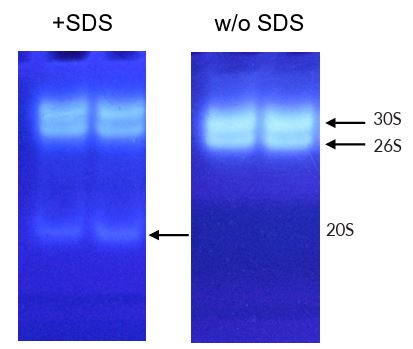
>95% (SDS-PAGE)
Sequence:
Human 26S Proteasome.
Source / Host:
HEK 293 cells
TAGs:
no TAG
Transportation:
Non-hazardous
UNSPSC Category:
Other Proteins
UNSPSC Number:
12352202
Use & Stability:
Stable for at least 1 year after receipt when stored at -80°C.