

DDB1 (human) (rec.) (His) (Avi) (Biotin)
Product Code:
SBB-SC0140
SBB-SC0140
Product Group:
Recombinant Proteins
Recombinant Proteins
Supplier:
South Bay Bio
South Bay Bio
Regulatory Status:
RUO
RUO
Target Species:
Human
Human
Product Types:
- Binding and Transport
- Scaffold, Adaptor, and Chaperone
- Tagged
Shipping:
Dry Ice
Dry Ice
Storage:
Short term: -80°C. Long term: -80°C
Short term: -80°C. Long term: -80°C

No additional charges, what you see is what you pay! *
Stay in control of your spending. These prices have no additional charges to UK mainland customers, not even shipping!
* Rare exceptions are clearly labelled (only 0.14% of items!).
* Rare exceptions are clearly labelled (only 0.14% of items!).
Multibuy discounts available! Contact us to find what you can save.
This product comes from: Switzerland.
Typical lead time: 10-14 working days.
Contact us for more accurate information.
Typical lead time: 10-14 working days.
Contact us for more accurate information.
- Further Information
- Documents
- Show All
Further Information
Alternate Names/Synonyms:
DNA Damage-binding Protein 1; DDB p127 Subunit; DNA Damage-binding Protein a (DDBa); HBV X-associated Protein 1 (XAP-1); UV-damaged DNA-binding Factor
Concentration:
Lot dependent.
EClass:
32160000
Form:
liquid
Formulation:
Liquid. In 25mM HEPES pH 7.5, 150mM NaCl, 0.1mM TCEP (no detergents or glycerol).
Handling Advice:
Aliquot to avoid freeze/thaw cycles.
Long Description:
Recombinant Protein. Recombinant human DDB1 (aa 1-1140) with a N-terminal 8x-His Tag followed by an Avi-Tag that was endogenous biotinylated. Produced in Sf21 cells. Liquid. In 25mM HEPES pH 7.5, 150mM NaCl, 0.1mM TCEP (no detergents or glycerol). DNA damage-binding protein 1, which is involved in both DNA repair and protein ubiquitination, is part of the UV-DDB complex and DCX (DDB1-CUL4-X-box) complexes, respectively. Core component of the UV-DDB complex (UV-damaged DNA-binding protein complex), a complex that recognizes UV-induced DNA damage and recruits proteins of the nucleotide excision repair pathway (the NER pathway) to initiate DNA repair. The UV-DDB complex preferentially binds to cyclobutane pyrimidine dimers (CPD), 6-4 photoproducts (6-4 PP), apurinic sites and short mismatches. Functions as a component of numerous distinct DCX (DDB1-CUL4-X-box) E3 ubiquitin-protein ligase complexes, which mediate the ubiquitination and subsequent proteasomal degradation of target proteins. The functional specificity of the DCX E3 ubiquitin-protein ligase complex is determined by the variable substrate recognition component recruited by DDB1. The protein has an N-terminal 8x-His Tag followed by an Avi-Tag that was endogenously biotinylated during expression in Sf21 Cells.
NCBI, Uniprot Number:
Q16531
Package Type:
Plastic Vial
Product Description:
DNA damage-binding protein 1, which is involved in both DNA repair and protein ubiquitination, is part of the UV-DDB complex and DCX (DDB1-CUL4-X-box) complexes, respectively. Core component of the UV-DDB complex (UV-damaged DNA-binding protein complex), a complex that recognizes UV-induced DNA damage and recruits proteins of the nucleotide excision repair pathway (the NER pathway) to initiate DNA repair. The UV-DDB complex preferentially binds to cyclobutane pyrimidine dimers (CPD), 6-4 photoproducts (6-4 PP), apurinic sites and short mismatches. Functions as a component of numerous distinct DCX (DDB1-CUL4-X-box) E3 ubiquitin-protein ligase complexes, which mediate the ubiquitination and subsequent proteasomal degradation of target proteins. The functional specificity of the DCX E3 ubiquitin-protein ligase complex is determined by the variable substrate recognition component recruited by DDB1. The protein has an N-terminal 8x-His Tag followed by an Avi-Tag that was endogenously biotinylated during expression in Sf21 Cells.
Purity:
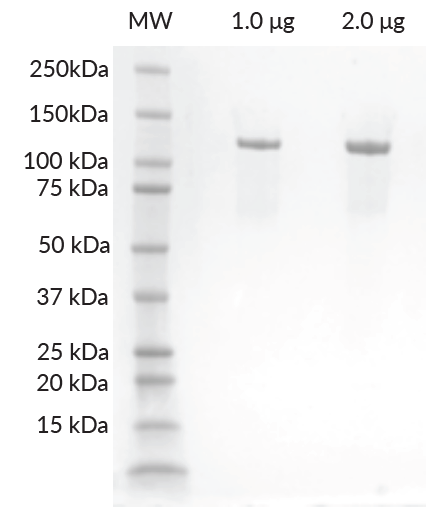
>98% (SDS-PAGE)
Sequence:
Recombinant human DDB1 (aa 1-1140) with a N-terminal 8x-His Tag followed by an Avi-Tag that was endogenous biotinylated.
Source / Host:
Sf21 cells
TAGs:
His
Transportation:
Non-hazardous
UNSPSC Category:
Other Proteins
UNSPSC Number:
12352202
Use & Stability:
Stable for at least 1 year after receipt when stored at -80°C.