

Human Hepatic Sinusoidal Endothelial Cells
Product Code:
SC-5000
SC-5000
Product Group:
Primary Cells
Primary Cells
Supplier:
Sciencell
Sciencell
Cell System:
Hepatic Cell System
Hepatic Cell System
Cell Type:
Endothelial Cells
Endothelial Cells
Species:
Human
Human
Host Type:
Human
Human
Regulatory Status:
RUO
RUO

No additional charges, what you see is what you pay! *
Stay in control of your spending. These prices have no additional charges to UK mainland customers, not even shipping!
* Rare exceptions are clearly labelled (only 0.14% of items!).
* Rare exceptions are clearly labelled (only 0.14% of items!).
Multibuy discounts available! Contact us to find what you can save.
This product comes from: United States.
Typical lead time: 10-14 working days.
Contact us for more accurate information.
Typical lead time: 10-14 working days.
Contact us for more accurate information.
- Further Information
- Documents
- References
- Related Products
- Show All
Further Information
Components:
Cells only
Extra Description:
Isolated from human liver. HHSEC are cryopreserved at passage one and delivered frozen. Each vial contains >5 x 10^5 cells in 1 ml volume.
Long Description:
Endothelial cells perform multiple physiological functions and are central to many pathological processes. The liver contains two distinct endothelial cell types: vascular and sinusoidal. Sinusoidal endothelial cells (SEC) are microvascular endothelial cells with a unique phenotype reminiscent of dendritic cells and a unique function as antigen-presenting cells for CD4^+ T cells. Thus, SEC represent a new type of organ-resident "non-professional" antigen-presenting cell that appears to be involved in the local control of the immune response and the induction of immune tolerance in the liver. The hepatic microenvironment, including the portal venous constituents and soluble mediators from sinusoidal cell populations, tightly control antigen presentation by SEC to avoid immune-mediated damage. SEC express well-characterized surface receptors and differ morphologically and metabolically from large-vessel endothelia. Previous studies have shown that SEC are dynamic regulators of porosity that respond rapidly and locally to environmental zonal stimuli during liver regeneration. SEC dysfunction and structural alterations have far-reaching repercussions for the whole liver.
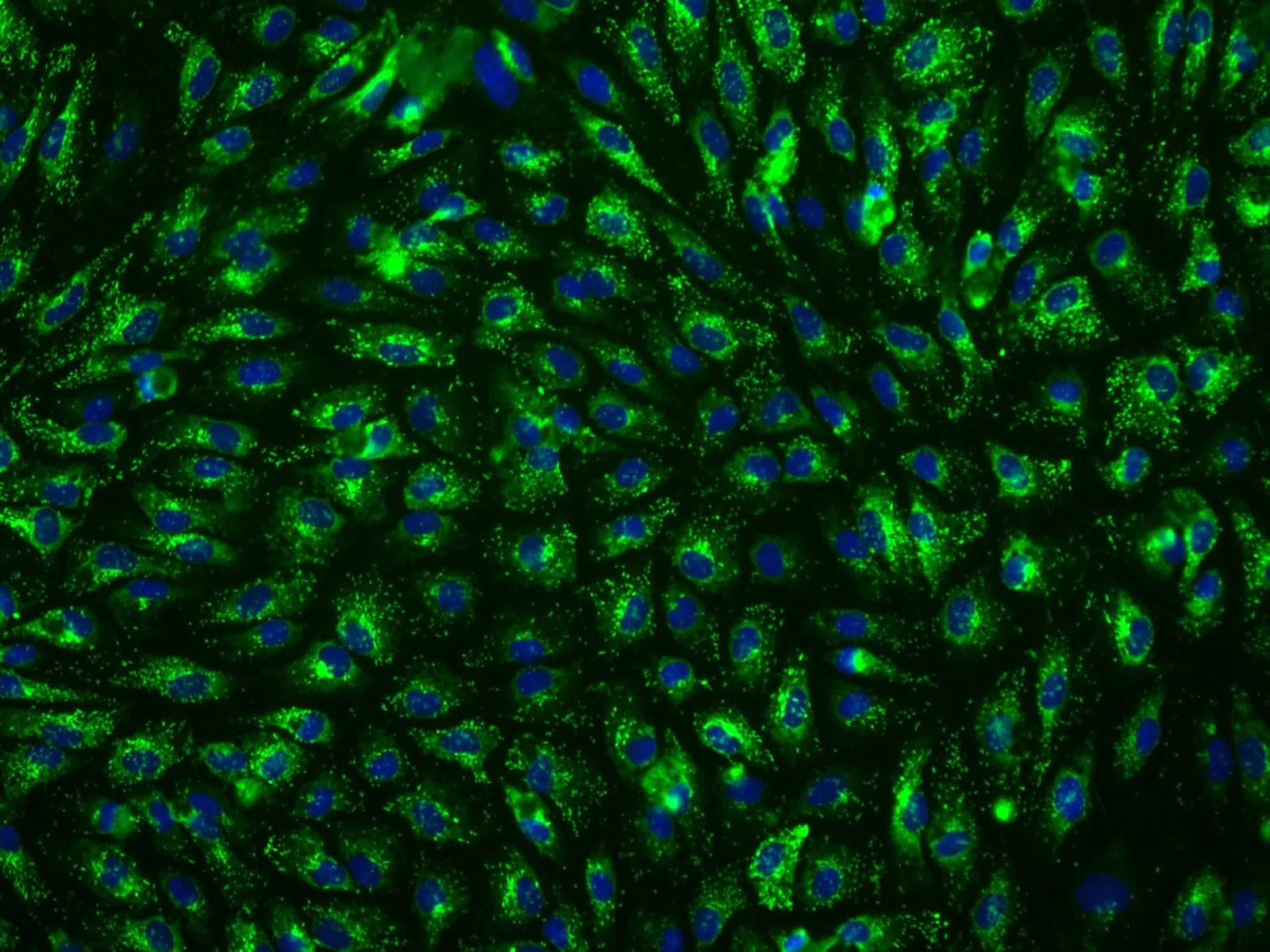
HHSEC from ScienCell Research Laboratories are isolated from human liver. HHSEC are cryopreserved at passage one and delivered frozen. Each vial contains >5 x 10^5 cells in 1 ml volume. HHSEC are characterized by immunofluorescence with antibodies specific to vWF/Factor VIII and/or CD31 (PECAM1). HHSEC are negative for HIV-1, HBV, HCV, mycoplasma, bacteria, yeast and fungi. HHSEC are guaranteed to further expand for 5 population doublings under the conditions provided by ScienCell Research Laboratories. Note: HHSEC are not expected to proliferate many times in culture, so we recommend using cells for experiments at earliest passage after initial plating.
Recommended Medium -
It is recommended to use Endothelial Cell Medium (ECM, Cat. #1001) for the culturing of HHSEC.
Documents
References
- https://pubmed.ncbi.nlm.nih.gov/20338920/
- https://pubmed.ncbi.nlm.nih.gov/20338920/
- https://kyushu-u.elsevierpure.com/en/publications/divergent-roles-of-prokineticin-receptors-in-the-endothelial-cell
- https://pubmed.ncbi.nlm.nih.gov/20578142/
- https://pubmed.ncbi.nlm.nih.gov/17675564/
- https://pubmed.ncbi.nlm.nih.gov/20491586/
- https://pubmed.ncbi.nlm.nih.gov/21427291/
- https://pubmed.ncbi.nlm.nih.gov/16440337/
- https://pubmed.ncbi.nlm.nih.gov/17406470/
- https://pubmed.ncbi.nlm.nih.gov/16269521/
- https://pubmed.ncbi.nlm.nih.gov/19632227/
- http://www.gastrojournal.org/article/S0016-5085(14)01332-8/pdf
- https://pubmed.ncbi.nlm.nih.gov/26087187/
- https://journals.plos.org/plosone/article?id=10.1371/journal.pone.0142134
- http://www.ncbi.nlm.nih.gov/pmc/articles/PMC4594676/pdf/jcmm0019-2341.pdf
- https://pubmed.ncbi.nlm.nih.gov/26733244/
- https://journals.plos.org/plosone/article?id=10.1371/journal.pone.0153805
- https://www.sciencedirect.com/science/article/pii/S2211124722018381
- https://pubmed.ncbi.nlm.nih.gov/36685431/