A TCR Tetramer is a reagent prepared by tetramerising biotinylated antigen-specific TCRs with the help of phycobiliprotein-labelled streptavidin.
TCR Tetramers
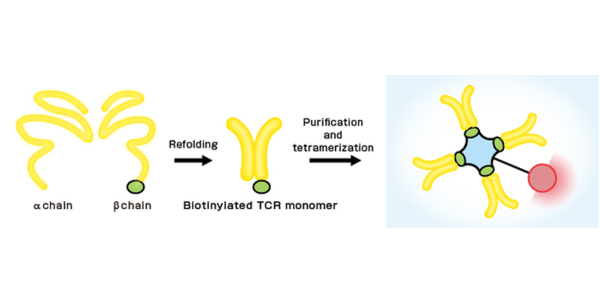

A TCR Tetramer is a reagent prepared by tetramerising biotinylated antigen-specific TCRs with the help of phycobiliprotein-labelled streptavidin.
Non-classical Major Histocompatibility Complex (MHC) molecules are non-polymorphic proteins implicated in both innate and adaptive immune responses.1,2 While classical MHCs present antigens to CD8+/CD4+ cells for further immune processing, non-classical MHCs also mediate activation or inhibition in natural killer (NK) cells.3 MBL
CD1d molecules are non-polymorphic MHC class I-like proteins. These are a type of non-classical MHCs. They present phospholipid and glycosphingolipid antigens to invariant Natural Killer T (iNKT) cells, a subset of CD1d-restricted T cells. This axis is involved in the
T cell receptors (TCRs) expressed on the surface of T cells specifically recognise and bind to complexes of major histocompatibility complex (MHC) molecules and peptide fragments. CD4+ T cells, which include helper and regulatory T cells, recognise complexes of MHC class
T cell receptors (TCRs) expressed on the surface of T cells specifically recognise and bind to complexes of major histocompatibility complex (MHC) molecules and peptide fragments expressed on the surface of antigen-presenting cells. CD8+ T cells, also called cytotoxic T

MBLI’s autophagy reagents include important targets such as LC3, p62/SQSTM1, ATG12, ATG14, ATG16L, ATG9, ULK1, and more.
The MHC Monomer is a sub-component of an MHC Tetramer. Biotinylated Monomers are available for most associated Tetramer products.
Adding another marker to a flow cytometry panel can present a challenge when trying to accommodate all markers of interest in one panel. However, there is a solution.
MBL International’s AMPK kinase assay kit can be used to measure the activity of AMPK, a cellular energy sensor.
Cervical cancer is the 4th most prevalent cancer among women, and the 7th most common cancer. MBLI provides HPV-related tetramers for use in research.